


A Data-Driven Strategy helps businesses use reliable information to make smarter decisions, improve operational efficiency, understand customers, and identify opportunities for revenue growth. Instead of depending primarily on assumptions or intuition, businesses can collect and analyze data to understand what is working, what needs improvement, and where resources should be allocated.
Modern businesses generate large amounts of information through websites, social media, sales systems, customer interactions, and digital marketing campaigns. When this information is organized and analyzed effectively, it can become a valuable business resource.
What Is a Data-Driven Strategy?
A Data-Driven Strategy is an approach where businesses use collected and analyzed information to guide decisions, solve problems, improve processes, and achieve measurable objectives.
Instead of asking only what happened, businesses can use data to explore why something happened and what action should be taken next. This creates a more structured approach to business planning.
Key Components of a Data-Driven Strategy
An effective strategy usually includes data collection, data organization, analysis, interpretation, implementation, and continuous measurement. Each stage contributes to turning raw information into useful business insights.
Businesses also need clear objectives. Collecting large amounts of data without knowing what decisions the data should support can create unnecessary complexity.
Why Data Matters for Business Decisions
Data can help businesses reduce uncertainty. Sales records, website activity, customer feedback, advertising performance, and operational metrics can reveal patterns that may not be obvious through observation alone. However, data should be accurate, relevant, and interpreted within the right context. Poor-quality data can lead to poor decisions.
Identify the Right Business Data
 Before building a data-driven system, businesses need to identify which information is most useful. The right data depends on the company’s goals, industry, customers, and operational model. Businesses should focus on information that can support specific decisions rather than collecting everything available.
Sales and Revenue Data
Sales data can reveal product performance, customer purchasing patterns, average order values, sales trends, and revenue changes. Businesses can use this information to understand which products generate demand, which periods produce stronger sales, and where potential revenue opportunities exist.
Website and Digital Data
Website analytics can show where visitors come from, which pages they view, how long they remain on the site, and where they leave. This information can help businesses identify content gaps, improve user experiences, and optimize pages that contribute to conversions.
Customer Feedback Data
Customer reviews, surveys, support conversations, and feedback forms provide qualitative information that numerical data may not fully explain. Combining feedback with quantitative data can help businesses understand both what customers are doing and why they may be behaving in certain ways.
Use Customer Behavior Analysis to Improve Decisions
Customer Behavior Analysis helps businesses understand how customers interact with products, websites, services, and marketing channels. It can reveal patterns related to browsing, purchasing, engagement, and retention. Understanding these patterns can help businesses create more relevant experiences and allocate resources more effectively.
Identify Customer Preferences
Businesses can analyze purchase history, product interactions, search behavior, content engagement, and other signals to understand customer preferences. These insights can help companies develop relevant products, personalize communications, and improve recommendations.
Understand the Customer Journey
Customer behavior data can reveal how people move from awareness to consideration and purchase. Businesses can identify where customers engage most and where they commonly stop progressing. Understanding these points can help companies improve landing pages, product information, checkout processes, and follow-up communication.
Segment Customers
Customer segmentation allows businesses to group audiences based on shared characteristics or behaviors. Segments may include new customers, repeat buyers, high-value customers, inactive users, or customers interested in specific products. Targeted strategies can then be developed for each group.
Apply Marketing Analytics to Improve Campaign Performance
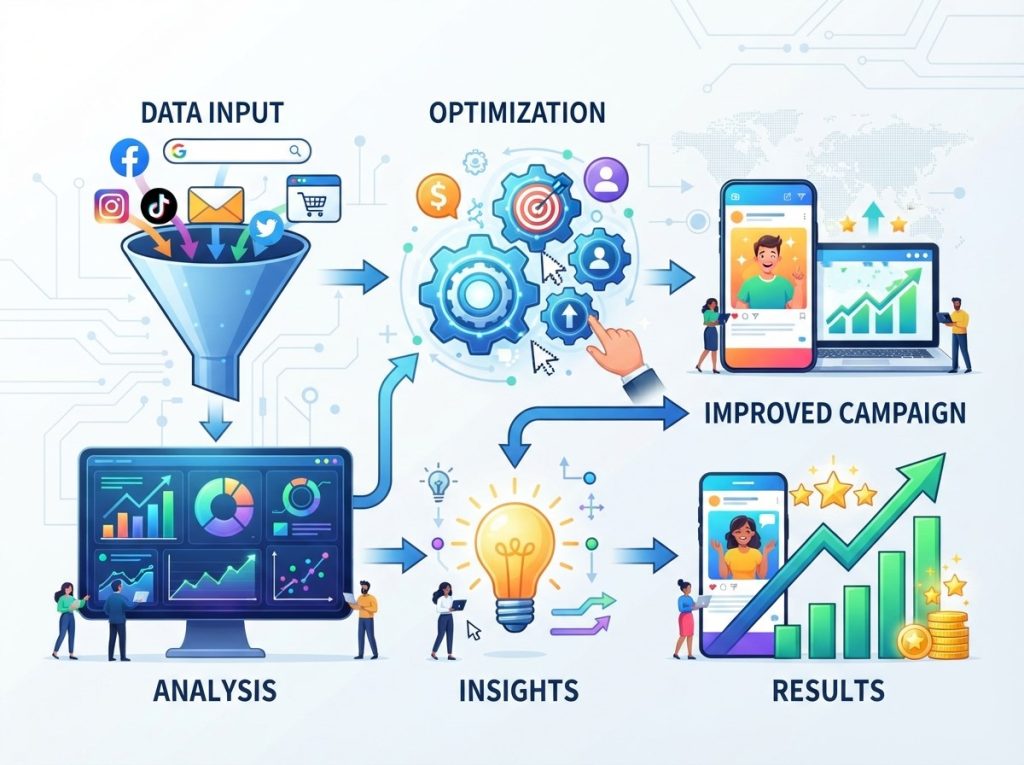 Marketing Analytics helps businesses evaluate the performance of their marketing activities. It connects campaign data with business outcomes so companies can understand which activities contribute to traffic, leads, conversions, and revenue.
Without measurement, businesses may continue spending resources on campaigns without knowing their actual impact.
Measure Campaign Performance
Businesses can track impressions, clicks, engagement, website visits, leads, conversion rates, and revenue. These metrics provide insight into how campaigns are performing.
However, businesses should avoid focusing on surface-level metrics alone. High traffic does not necessarily mean high revenue if visitors do not take meaningful actions.
Optimize Marketing Budgets
Marketing data can help businesses identify which channels generate valuable results. Companies can compare the performance of search marketing, social media, email, content marketing, paid advertising, and other channels. Budget allocation can then be adjusted according to business objectives and measured performance.
Test Different Marketing Approaches
Data allows businesses to compare different messages, offers, headlines, designs, audiences, and calls to action. A/B testing and other controlled experiments can help determine which variations perform better. Testing should be conducted with clear objectives and sufficient data to support reliable conclusions.
Use Customer Data Analysis for Personalization
Customer Data Analysis involves examining customer information to identify useful patterns and insights. When performed responsibly, it can help businesses create more relevant customer experiences. Personalization should provide genuine value rather than simply using customer information for excessive targeting.
Create Relevant Offers
Businesses can use customer information to understand product interests, purchasing frequency, and engagement patterns. This can help companies present relevant products, services, or offers. For example, a customer who regularly purchases a particular product category may be interested in related products or educational content.
Improve Customer Communication
Customer data can help businesses determine which messages are relevant to different customer groups. New customers may need onboarding information, while existing customers may benefit from loyalty programs or product updates. Relevant communication can reduce unnecessary messages and improve engagement.
Support Customer Retention
Data can help identify customers who may be becoming inactive. Changes in purchasing frequency, website activity, or engagement may indicate that a customer needs additional support or relevant communication. Businesses can use these insights to create retention campaigns and improve the customer experience.
Improve Operational Efficiency With Data
Data-driven strategies are not limited to marketing. Businesses can also use data to improve internal operations, reduce waste, and allocate resources more effectively. Operational data can help companies identify delays, recurring problems, unnecessary expenses, and process inefficiencies.
Monitor Business Processes
Businesses can track order processing time, customer support response time, inventory levels, employee productivity, and other operational metrics. Regular monitoring can reveal bottlenecks that may otherwise remain unnoticed.
Automate Repetitive Tasks
Data can help businesses identify processes that are repetitive and suitable for automation. Examples may include reporting, customer notifications, inventory alerts, appointment reminders, and routine administrative tasks. Automation can save time while allowing employees to focus on activities that require creativity, judgment, or direct customer interaction.
Reduce Operational Costs
By examining expenses and process performance, businesses can identify areas where resources may be used inefficiently. Cost reduction should not automatically mean cutting resources. Instead, businesses should look for ways to eliminate unnecessary work while maintaining service quality.
Use Predictive Insights for Future Planning
Historical data can help businesses identify patterns that may be useful for future planning. Predictive analysis can support demand forecasting, inventory planning, customer retention, and sales planning. Predictions are not guarantees, so businesses should consider uncertainty and changing market conditions.
Forecast Customer Demand
Sales history and seasonal patterns can help businesses estimate future demand. Better forecasts can support inventory decisions and reduce the risk of overstocking or stock shortages. Businesses should regularly update forecasts as new information becomes available.
Identify Potential Sales Opportunities
Customer activity and purchasing patterns can reveal opportunities for cross-selling, upselling, or re-engagement. Sales teams can use these insights to prioritize prospects and focus efforts on customers who may have a relevant need.
Build a Data-Driven Marketing Funnel
A marketing funnel can become more effective when businesses measure customer behavior at each stage. Data can show how many people move from awareness to engagement, lead generation, consideration, and purchase. This makes it easier to identify areas that require improvement.
Measure Each Funnel Stage
Businesses should track appropriate metrics at each stage. Awareness may involve reach and traffic, while consideration may involve content engagement and product page visits.
At the conversion stage, businesses can track leads, purchases, conversion rates, and revenue. Comparing these stages helps identify where potential customers are being lost.
Improve Conversion Opportunities
If many visitors reach a landing page but few complete a desired action, the business can investigate the page design, offer, messaging, form, or customer experience. Data can guide improvements rather than relying entirely on assumptions.
Create a Data-Driven Culture
Technology alone cannot create a data-driven organization. Employees and managers need to understand how data supports their responsibilities and decisions. A data-driven culture encourages teams to ask meaningful questions, evaluate evidence, and measure outcomes.
Train Employees to Use Data
Employees should understand the basic metrics relevant to their roles. Marketing teams may need campaign analytics, while sales teams may focus on customer and revenue data. Training can improve confidence and reduce the risk of misinterpreting information.
Establish Clear Data Ownership
Businesses should determine who is responsible for collecting, maintaining, analyzing, and reporting important data. Clear ownership improves accountability and can reduce inconsistencies between departments.
Protect Data Quality and Privacy
Data-driven strategies depend on accurate and responsibly managed information. Businesses should establish processes for checking data quality, protecting sensitive information, and controlling access. Privacy requirements can vary depending on the location, industry, and type of information collected.
Maintain Accurate Data
Duplicate records, outdated information, missing fields, and inconsistent formatting can reduce the usefulness of business data. Regular data cleaning and validation can help maintain reliable datasets.
Protect Customer Information
Businesses should collect only information they genuinely need and use appropriate security measures to protect it. Access controls, authentication, encryption, secure storage, and employee training can help reduce data security risks.
Measure the Results of Your Data-Driven Strategy
 A data-driven approach should itself be measured. Businesses need to determine whether their strategy is improving efficiency, increasing revenue, reducing costs, or supporting other objectives. The metrics should reflect the organization’s specific goals.
Track Key Performance Indicators
Key performance indicators may include revenue growth, conversion rates, customer acquisition cost, customer retention, average order value, operational costs, and customer satisfaction. Tracking these metrics over time can reveal whether strategic changes are producing meaningful results.
Review and Improve Regularly
Data-driven strategies should not remain static. Markets, customers, competitors, and technologies change over time. Regular reviews allow businesses to update their assumptions, adjust priorities, and test new approaches based on current information.
Common Data-Driven Strategy Mistakes to Avoid
One common mistake is collecting too much data without defining clear objectives. Large datasets are not automatically useful if teams do not know which questions they are trying to answer. Another problem is relying on inaccurate or outdated information. Poor-quality data can produce misleading insights and ineffective decisions.
Businesses may also focus too heavily on individual metrics instead of examining the broader context. A rise in website traffic, for example, may look positive but may not improve revenue if the traffic is poorly targeted. Finally, companies should avoid ignoring human judgment. Data can support decisions, but business experience, customer feedback, industry knowledge, and changing circumstances also matter.
Conclusion
A strong Data-Driven Strategy can help businesses improve efficiency, understand customers, optimize marketing, reduce unnecessary costs, and identify opportunities for revenue growth. By turning reliable information into actionable insights, companies can make decisions based on evidence rather than assumptions alone.
Customer Behavior Analysis helps businesses understand how people interact with their products and services. Marketing Analytics supports better campaign measurement and budget allocation, while Customer Data Analysis can improve personalization, communication, and retention.
Frequently Asked Questions
1. What is a Data-Driven Strategy?
A Data-Driven Strategy is an approach that uses reliable business data and analysis to guide decisions, improve processes, understand customers, and achieve measurable business objectives.
2. Why is a Data-Driven Strategy important?
It can help businesses reduce uncertainty, identify opportunities, improve efficiency, understand customer needs, optimize marketing activities, and make better use of available resources.
3. How does Customer Behavior Analysis help businesses?
Customer Behavior Analysis helps businesses understand how customers browse, purchase, interact, and engage. These insights can support personalization, segmentation, customer journey improvements, and retention strategies.
4. What is Marketing Analytics?
Marketing Analytics is the process of analyzing marketing data to understand campaign performance, customer engagement, conversions, and revenue contribution. It helps businesses make more informed marketing decisions.
5. Why is Customer Data Analysis important?
Customer Data Analysis can reveal patterns in customer preferences, purchasing behavior, engagement, and retention. Businesses can use these insights to improve customer experiences and create more relevant communication.
6. Can a Data-Driven Strategy increase revenue?
It can support revenue growth by identifying sales opportunities, improving marketing performance, increasing customer retention, optimizing pricing or offers, and helping businesses allocate resources more effectively.
7. How can businesses improve operational efficiency with data?
Businesses can analyze processes, costs, response times, inventory, employee workflows, and other operational metrics. These insights can reveal bottlenecks and opportunities for automation or process improvement.
8. What data should a business collect?
The appropriate data depends on business objectives. Common sources include sales data, customer information, website analytics, marketing performance, transaction records, customer feedback, and operational metrics.
9. How can businesses maintain data quality?
Businesses can use regular data cleaning, validation, standardization, duplicate removal, access controls, and clear data ownership processes to maintain accurate and reliable information.
10. How do you measure the success of a Data-Driven Strategy?
Success can be measured through KPIs such as revenue growth, conversion rate, customer retention, acquisition cost, operational costs, customer satisfaction, and marketing performance. Metrics should match the company’s specific objectives.



Leave a Reply