


Predictive Analytics is becoming an important part of modern business strategy because it helps organizations use historical and current data to anticipate future outcomes. Instead of relying only on assumptions or past experiences, businesses can analyze patterns, trends, and customer information to make more informed decisions. Predictive models can support sales forecasting, customer engagement, marketing planning, risk management, and operational improvements.
As businesses collect larger amounts of information across websites, applications, social platforms, and customer interactions, predictive technologies provide a structured way to turn that information into useful insights. When combined with Customer Behavior Analysis, Marketing Analytics, and Customer Data Analysis, predictive analytics can help businesses understand what may happen next and prepare more effectively.
What Is Predictive Analytics?
Predictive Analytics uses data, statistical techniques, machine learning, and predictive models to estimate possible future outcomes. It examines historical patterns and current signals to identify relationships that may help businesses anticipate customer actions, market changes, demand, and potential risks.
How Predictive Analytics Works
The process generally begins with collecting relevant data from multiple business sources. This information is cleaned, organized, and analyzed to identify meaningful patterns. Predictive models then use these patterns to estimate potential outcomes. Businesses can use these predictions to support planning, marketing, sales, customer service, and operational decisions.
The accuracy of predictions depends on data quality, model selection, and the relevance of the information being analyzed. Predictive analytics should therefore complement human judgment rather than completely replace it.
Why Businesses Use Predictive Analytics
Businesses use predictive analytics to move from reactive decision-making toward more proactive planning. Instead of waiting for a problem or opportunity to appear, companies can identify possible scenarios earlier.
For example, a retailer may analyze previous purchasing patterns to estimate future product demand. A marketing team may predict which customers are more likely to respond to a campaign. A service provider may identify customers who could be at risk of leaving.
How Predictive Analytics Supports Better Business Decisions
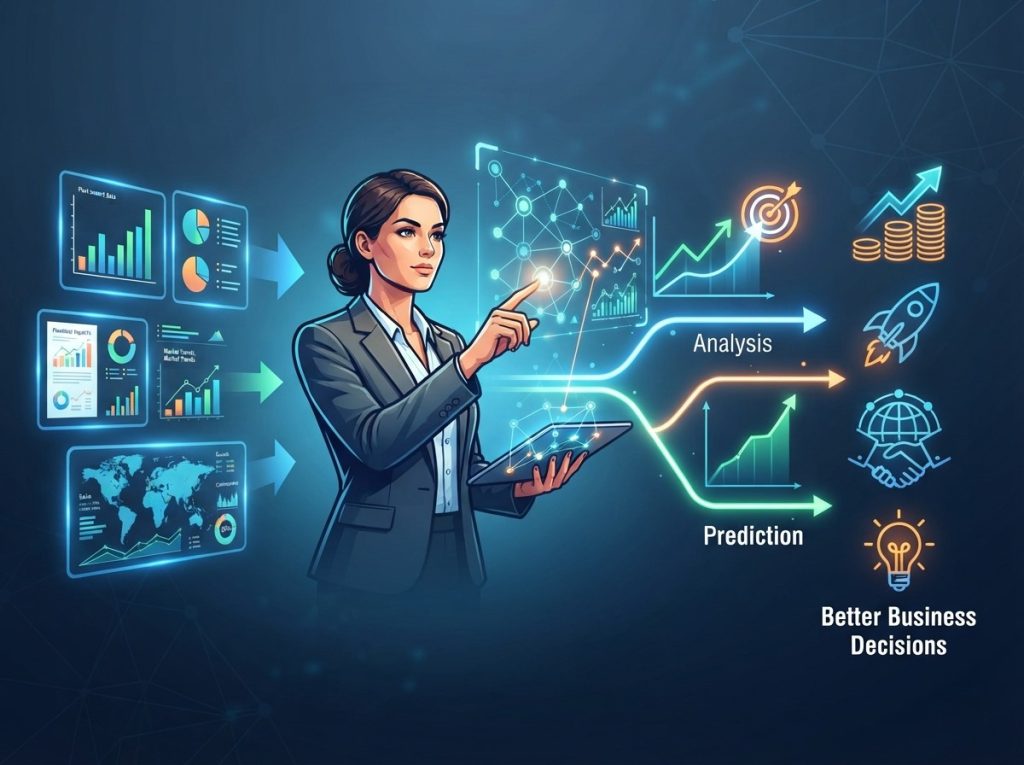 Predictive analytics can improve decision-making by providing businesses with evidence-based insights about potential future events. These insights allow managers and teams to evaluate opportunities, identify risks, allocate resources, and develop strategies based on measurable information.
Improving Forecasting and Planning
Accurate forecasting can help businesses plan inventory, staffing, budgets, marketing campaigns, and sales activities more effectively. Predictive models can examine previous performance and current market signals to identify potential future demand.
Better forecasting can also reduce unnecessary spending and improve resource allocation. While predictions are not guaranteed outcomes, they can provide businesses with useful scenarios for planning.
Identifying Business Risks
Risk identification is another important application of predictive analytics. Businesses can analyze patterns that may indicate payment problems, customer churn, operational disruptions, or unusual transactions.
Early identification gives teams more time to investigate the situation and take appropriate action. This proactive approach can help reduce avoidable losses while supporting stronger business planning.
Using Customer Data for Predictive Insights
Customer information provides valuable signals for understanding future behavior. Businesses can analyze interactions, purchases, preferences, engagement levels, and other relevant information to identify patterns that may influence future customer decisions.
The Role of Customer Data Analysis
Customer Data Analysis helps organizations understand how customers interact with their products, services, and marketing channels. Predictive analytics can extend this process by using historical customer information to estimate future actions.
For example, businesses can analyze previous purchases, website activity, email engagement, and service interactions to identify customers who may be interested in a particular offer. These insights can help companies create more relevant experiences.
Predicting Customer Needs
Customer needs can change based on behavior, preferences, market conditions, and previous interactions. Predictive models can help businesses identify patterns that suggest what customers may need next.
For example, an online store can analyze previous purchases to recommend related products. A software company may use customer activity data to identify users who could benefit from additional features or support.
Predictive Analytics and Customer Behavior
Understanding customers is essential for developing effective marketing and sales strategies. Customer Behavior Analysis focuses on examining how customers search, browse, purchase, interact, and respond to different experiences.
Understanding Buying Patterns
Predictive analytics can analyze historical buying patterns to identify trends in customer behavior. Businesses may discover that certain customers tend to purchase specific products together or make purchases during particular periods.
These insights can support product recommendations, campaign planning, inventory decisions, and customer engagement strategies. Businesses can also identify behavioral patterns that may be difficult to detect through manual analysis.
Predicting Customer Churn
Customer churn can affect recurring revenue and long-term growth. Predictive models can examine factors such as declining engagement, reduced purchases, support interactions, or changes in account activity.
When certain patterns are associated with customer churn, businesses can identify potentially at-risk customers and review appropriate retention strategies. This gives teams an opportunity to respond before a customer relationship is lost.
The Role of Marketing Analytics
Marketing Analytics helps businesses measure and understand the performance of marketing activities. When combined with predictive analytics, it can provide additional insight into what marketing outcomes may occur under different conditions.
Improving Campaign Planning
Marketing teams can use historical campaign data to understand which channels, messages, audiences, and offers have produced specific results. Predictive models can then help estimate how similar campaigns may perform.
This information can support campaign planning and budget allocation. Instead of distributing resources equally across every channel, businesses can use available evidence to investigate where future opportunities may exist.
Improving Audience Segmentation
Different customers may respond differently to the same campaign. Predictive analytics can help identify groups based on behavior, purchasing patterns, engagement, or other relevant characteristics.
Marketing teams can use these insights to create more targeted campaigns. This can improve message relevance and help businesses avoid sending identical communications to customers with very different needs.
Predictive Analytics for Sales Growth
 Sales teams can use predictive insights to improve prospect prioritization, revenue forecasting, and customer relationship management. Historical sales information can reveal patterns that help teams understand which opportunities may require attention.
Prioritizing Sales Opportunities
Predictive models can examine customer and prospect information to identify patterns associated with successful conversions. Sales teams can use these insights to determine which opportunities deserve further investigation.
This does not mean that every prediction will be correct. Instead, predictive insights provide another information source that sales professionals can combine with direct customer communication and business knowledge.
Forecasting Revenue
Revenue forecasting helps organizations plan budgets, staffing, inventory, and investments. Predictive analytics can use previous sales results, seasonal trends, customer activity, and other relevant data to create potential revenue scenarios.
Regularly updating forecasts as new data becomes available can help businesses respond to changing market conditions. This creates a more flexible approach to financial and operational planning.
Improving Customer Experience
Customer experience can influence satisfaction, retention, engagement, and long-term relationships. Predictive analytics can help businesses identify customer needs and potential issues before they become larger problems.
Personalizing Customer Interactions
Predictive insights can help businesses determine which products, services, content, or offers may be relevant to specific customers. This can support personalized recommendations across websites, email campaigns, applications, and other channels.
When personalization is based on meaningful customer information rather than assumptions, businesses can create more relevant interactions while reducing unnecessary communication.
Anticipating Customer Service Needs
Customer service teams can also benefit from predictive insights. Businesses can analyze previous support requests, product usage, and customer interactions to identify recurring issues or customers who may need additional assistance.
This can help organizations prepare resources more effectively and improve the overall service experience.
Benefits of Data-Driven Decision Making
Data-driven decision-making allows businesses to use measurable information when evaluating strategies and opportunities. Predictive analytics strengthens this approach by adding a forward-looking perspective.
Faster and More Informed Decisions
Predictive insights can help teams evaluate large amounts of information more efficiently. Instead of manually reviewing every data point, decision-makers can focus on patterns and predictions that are relevant to a specific business question.
This can support faster strategic discussions while still requiring human review and business context.
Better Resource Allocation
Businesses often have limited budgets, employees, time, and other resources. Predictive analytics can help identify areas that may require more or fewer resources based on historical and current patterns.
For example, companies can use demand predictions to improve inventory planning or analyze marketing performance to evaluate potential budget allocation.
Challenges of Using Predictive Analytics
Although predictive analytics can provide valuable insights, businesses need to understand its limitations. Poor-quality data, inappropriate models, biased datasets, and changing market conditions can affect predictions.
Data Quality and Accuracy
Predictions depend heavily on the quality of the information used to create them. Incomplete, outdated, duplicated, or inaccurate data can reduce the usefulness of predictive models.
Businesses should establish appropriate data management processes and regularly review the information used for analysis.
Privacy and Responsible Data Use
Customer information should be handled responsibly. Businesses need appropriate policies for collecting, storing, analyzing, and using customer data.
Transparency, security, access controls, and compliance with applicable privacy requirements are important considerations when implementing predictive analytics systems.
How to Implement Predictive Analytics Effectively
A successful predictive analytics strategy requires more than simply adopting a new technology. Businesses should begin with clear objectives and identify the data required to answer specific business questions.
Define Clear Business Goals
Organizations should first determine what they want predictive analytics to accomplish. Goals may include improving demand forecasting, reducing churn, increasing campaign effectiveness, or improving customer service. A clear objective makes it easier to select appropriate data, metrics, models, and evaluation methods.
Start With Reliable Data
Businesses should review the quality and availability of their data before building predictive models. Information from CRM systems, websites, sales platforms, marketing channels, and customer service systems may need to be organized before analysis. Reliable data provides a stronger foundation for meaningful predictive insights.
Monitor and Improve Models
Predictive models should not be treated as permanent solutions. Customer behavior, markets, products, and business conditions can change over time. Businesses should monitor model performance and update models when necessary. Regular evaluation can help identify changes in prediction quality and improve future decision-making.
Future Role of Predictive Analytics in Business
 As organizations continue generating more digital information, predictive analytics is likely to remain an important part of business intelligence. Advances in machine learning, automation, and artificial intelligence are making it easier to process complex datasets and identify patterns.
Businesses can increasingly combine predictive insights with real-time information to support faster decisions. However, effective implementation will continue to depend on data quality, responsible practices, clear objectives, and human oversight.
Frequently Asked Questions
1. What is Predictive Analytics?
Predictive Analytics is a data analysis approach that uses historical and current information to estimate possible future outcomes. Businesses use it for forecasting, customer insights, risk analysis, sales planning, and marketing decisions.
2. How does Predictive Analytics support decision-making?
It provides businesses with insights into possible future outcomes based on existing data. These insights can help teams identify opportunities, evaluate risks, forecast demand, and plan resources more effectively.
3. What is Customer Behavior Analysis?
Customer Behavior Analysis involves studying customer actions, preferences, purchases, engagement, and interactions. Businesses use these insights to understand customer needs and improve marketing, sales, and customer experiences.
4. How does Marketing Analytics work with Predictive Analytics?
Marketing Analytics measures marketing performance, while predictive analytics can use that information to identify potential future outcomes. Together, they can support campaign planning, audience targeting, budget decisions, and performance forecasting.
5. What is the role of Customer Data Analysis?
Customer Data Analysis helps businesses understand information collected from customer interactions. It can reveal purchasing patterns, preferences, engagement trends, and other insights that can support better customer strategies.
6. Can Predictive Analytics improve customer retention?
Yes. Predictive analytics can identify behavioral patterns associated with declining engagement or potential churn. Businesses can investigate these signals and develop appropriate retention strategies based on their customer relationships.
7. Can small businesses use Predictive Analytics?
Yes. Small businesses can use predictive analytics when they have sufficient relevant data and a clear business objective. They can start with focused use cases such as sales forecasting, customer segmentation, or campaign analysis.
8. Is Predictive Analytics always accurate?
No. Predictive analytics estimates possible outcomes rather than guaranteeing them. Accuracy can be affected by data quality, model selection, changing market conditions, and unexpected customer behavior.
9. What industries use Predictive Analytics?
Predictive analytics can be used across industries such as retail, finance, healthcare, manufacturing, education, technology, telecommunications, and professional services. The specific applications depend on available data and business objectives.
10. How can businesses get started with Predictive Analytics?
Businesses should begin by identifying a specific problem they want to solve. They can then evaluate available data, define relevant metrics, select an appropriate analytical approach, test results, and continuously monitor performance.
Final Thoughts
Predictive analytics gives businesses a forward-looking approach to data-driven decision-making. By combining historical information with current data, organizations can identify patterns, anticipate possible outcomes, and improve planning across marketing, sales, customer service, and operations. Customer Behavior Analysis, Marketing Analytics, and Customer Data Analysis can further strengthen these insights by providing a deeper understanding of customers and their interactions. The key is to use predictive insights as decision-support tools rather than treating forecasts as guaranteed outcomes. With reliable data, clear objectives, responsible practices, and continuous evaluation, businesses can use predictive analytics to make more informed and adaptable decisions.



Leave a Reply