

Business profitability depends on how effectively an organization manages its investments, resources, and operational expenses. Companies often invest in marketing campaigns, technology, employee development, infrastructure, and customer acquisition to achieve sustainable growth. However, spending money does not automatically guarantee positive financial results. Businesses need reliable methods to evaluate whether their investments are generating sufficient returns. ROI Analysis provides a practical framework for measuring investment performance, identifying profitable opportunities, and understanding how financial resources contribute to business objectives.
By examining costs, revenue, and measurable outcomes, organizations can make informed decisions about future investments. Effective ROI Analysis also helps businesses identify inefficient spending, improve marketing strategies, and allocate budgets more strategically. When combined with Business Intelligence, Marketing Intelligence, and Audience Segmentation, it becomes a valuable approach to improving financial performance and maximizing long-term profitability.
Understanding ROI Analysis and Its Importance in Business
ROI Analysis is a financial evaluation method used to determine how much return a business generates from a particular investment compared with its cost. It helps organizations understand whether their financial activities are producing profitable outcomes and whether available resources are being used effectively.
The return on investment formula provides a straightforward way to measure financial performance. Businesses can calculate ROI by subtracting the investment cost from the investment return, dividing the result by the original investment cost, and multiplying it by 100 to express the outcome as a percentage.
For example, if a company invests $10,000 in a marketing campaign and generates $15,000 in attributable revenue, its basic ROI is 50%. However, businesses should distinguish revenue from actual profit when evaluating investment performance. A more meaningful calculation uses the net financial gain after relevant expenses.
Why ROI Matters for Business Profitability
ROI helps business owners understand which investments contribute most effectively to financial growth. Without proper evaluation, companies may continue spending money on activities that generate limited returns while overlooking opportunities with stronger profit potential.
Regular ROI evaluation encourages financial accountability and supports better investment planning. It also allows management teams to compare different projects, identify unnecessary expenses, and prioritize activities that contribute to sustainable business performance.
Measuring Financial Performance Accurately
Accurate ROI measurement requires reliable financial information and clearly defined investment objectives. Businesses should consider all relevant costs, including operational expenses, employee time, technology fees, advertising expenditure, and ongoing maintenance.
Organizations must also establish appropriate measurement periods because different investments generate returns over different timeframes. A marketing campaign may produce immediate results, while technology investments or employee training programs may deliver benefits gradually over several months or years.
Using Business Intelligence to Improve ROI Analysis
 Modern businesses generate large amounts of information through sales platforms, customer relationship management systems, financial applications, and marketing channels. Business Intelligence helps organizations collect, organize, and analyze this information to understand performance patterns and support informed decisions.
When integrated with ROI Analysis, business intelligence tools provide a clearer understanding of how different investments affect profitability. Companies can examine revenue trends, operational expenses, customer behavior, and departmental performance through centralized reporting systems.
Turning Business Data Into Financial Insights
Business data becomes valuable when organizations can transform raw information into meaningful financial insights. Analytics platforms help management teams identify which products, services, departments, and operational activities generate the strongest returns.
For example, an ecommerce company may compare the performance of different product categories by examining sales revenue, advertising costs, delivery expenses, and customer acquisition costs. This information helps management identify profitable product segments and adjust investment priorities.
Using Performance Dashboards for ROI Monitoring
Performance dashboards make it easier to monitor important financial indicators without manually reviewing multiple reports. Businesses can create dashboards that display investment costs, generated revenue, conversion rates, customer acquisition costs, and profit margins.
These reports allow decision-makers to identify performance changes and investigate potential problems before they significantly affect profitability. Regular dashboard reviews also improve transparency by helping different departments understand how their activities contribute to broader financial objectives.
Improving Marketing Profitability Through ROI Analysis
Marketing investments can represent a significant portion of business expenditure, making performance measurement essential for effective budget management. ROI Analysis allows organizations to evaluate whether advertising campaigns, promotional activities, content strategies, and customer acquisition initiatives are generating sufficient financial returns.
Marketing Intelligence strengthens this process by providing insights into campaign performance, customer preferences, competitor activities, and market trends. Combining these insights with financial measurements helps businesses understand not only how much revenue marketing generates but also which strategies contribute most effectively to profitability.
Evaluating Marketing Campaign Performance
Businesses often use multiple marketing channels, including search engine optimization, paid advertising, email marketing, and social media campaigns. Each channel has different costs, conversion patterns, and revenue contributions.
ROI evaluation helps organizations compare these channels using consistent financial measurements. For example, a company may discover that email marketing generates more profit per dollar spent than a particular paid advertising campaign. Management can use this information to adjust campaign budgets and improve overall marketing efficiency.
However, businesses should consider attribution challenges before comparing channels. Customers may interact with several marketing touchpoints before purchasing, so relying entirely on the last interaction can produce misleading conclusions.
Reducing Unnecessary Marketing Expenses
Unnecessary marketing expenditure can reduce profitability even when campaigns generate substantial traffic or engagement. Businesses should examine whether their promotional activities contribute to meaningful outcomes such as qualified leads, completed purchases, customer retention, and repeat revenue.
By regularly analyzing campaign costs and financial results, organizations can identify underperforming activities and make appropriate adjustments. This approach helps marketing teams prioritize strategies that generate measurable business value rather than focusing exclusively on impressions, clicks, or follower growth.
Using Audience Segmentation to Increase Investment Returns
Not every customer has the same interests, purchasing behavior, or financial value. Treating all customers as a single group can result in inefficient marketing expenditure and less effective communication. Audience Segmentation helps businesses divide customers into meaningful groups based on shared characteristics, preferences, purchasing patterns, and engagement levels.
When connected with ROI Analysis, audience segmentation helps organizations understand which customer groups generate the strongest financial returns. Businesses can use these insights to develop targeted campaigns, improve customer experiences, and allocate marketing resources more effectively.
Identifying High-Value Customer Groups
Customer segmentation allows businesses to evaluate different audiences according to purchasing frequency, average order value, customer lifetime value, and acquisition costs. These measurements help organizations identify customer groups that contribute more significantly to long-term profitability.
For example, an online retailer may discover that returning customers generate higher revenue at a lower acquisition cost than newly acquired customers. This insight can encourage the business to invest more strategically in loyalty programs, personalized offers, and customer retention activities.
Creating More Profitable Marketing Campaigns
Segment-based marketing helps organizations deliver relevant messages to specific customer groups. Instead of spending the same amount on every audience, businesses can prioritize segments that demonstrate stronger purchasing intent and better conversion potential.
This approach can improve campaign efficiency by reducing irrelevant advertising expenditure. Businesses can also test different promotional strategies across customer segments and compare their financial outcomes to identify the most effective combinations.
Strategic Budget Allocation for Better ROI
Budget allocation directly influences business profitability because financial resources are limited and every investment involves an opportunity cost. Organizations need to understand which activities deserve additional funding and which expenses require reconsideration.
ROI Analysis supports strategic budget allocation by comparing expected financial returns with investment requirements. Businesses can use historical performance, market information, and operational forecasts to prioritize investments that align with their financial objectives.
Prioritizing High-Performing Investments
High-performing investments deserve attention because they demonstrate the potential to generate stronger financial outcomes. However, businesses should evaluate whether these results are sustainable before increasing their budgets.
For example, a company may identify a sales channel that consistently generates profitable customers. Management can gradually increase investment in that channel while monitoring customer acquisition costs, conversion rates, and profit margins. This controlled approach reduces the risk of spending too aggressively based on temporary performance improvements.
Balancing Short-Term and Long-Term Returns
Not every profitable investment produces immediate financial benefits. Technology upgrades, employee training, product development, and customer relationship improvements may require substantial initial spending before generating measurable returns.
Businesses should evaluate both immediate financial outcomes and longer-term benefits when making investment decisions. A balanced investment strategy considers profitability, operational improvements, risk exposure, and future growth opportunities rather than focusing exclusively on short-term revenue.
Using Customer Acquisition Cost and Lifetime Value in ROI Analysis
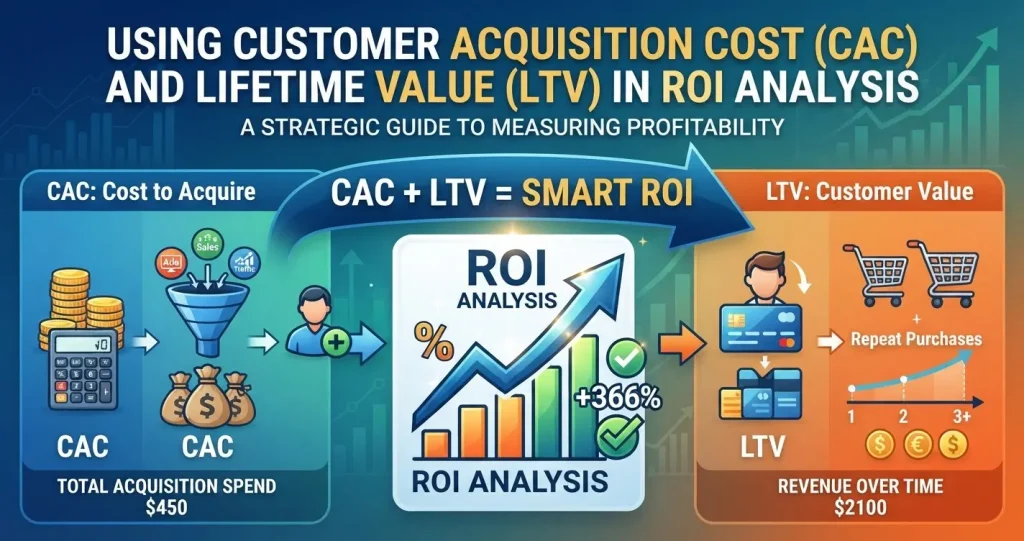 Customer acquisition cost and customer lifetime value are important measurements for understanding customer-related profitability. Acquisition cost represents the amount a business spends to gain a new customer, while lifetime value estimates the revenue or profit a customer may generate throughout the relationship.
When these measurements are included in ROI Analysis, organizations can evaluate whether their customer acquisition strategies are financially sustainable. They also help businesses understand how customer retention and purchasing behavior influence long-term investment returns.
Understanding Customer Acquisition Costs
Customer acquisition cost includes relevant expenses associated with attracting and converting new customers. These may involve advertising expenditure, marketing salaries, promotional campaigns, sales commissions, and other acquisition-related costs.
Businesses should calculate acquisition costs consistently across different marketing channels and customer segments. Comparing these figures with customer profitability helps management identify acquisition strategies that generate sustainable financial value.
Improving Customer Lifetime Value
Customer lifetime value can increase when businesses improve customer satisfaction, retention, repeat purchases, and relationship management. Organizations can support these improvements through personalized communication, reliable customer service, loyalty programs, and relevant product recommendations.
Comparing customer lifetime value with acquisition cost provides a broader understanding of customer investment performance. However, businesses should use consistent revenue or profit-based measurements when comparing these figures to avoid overstating customer profitability.
Measuring Operational Efficiency Through ROI Analysis
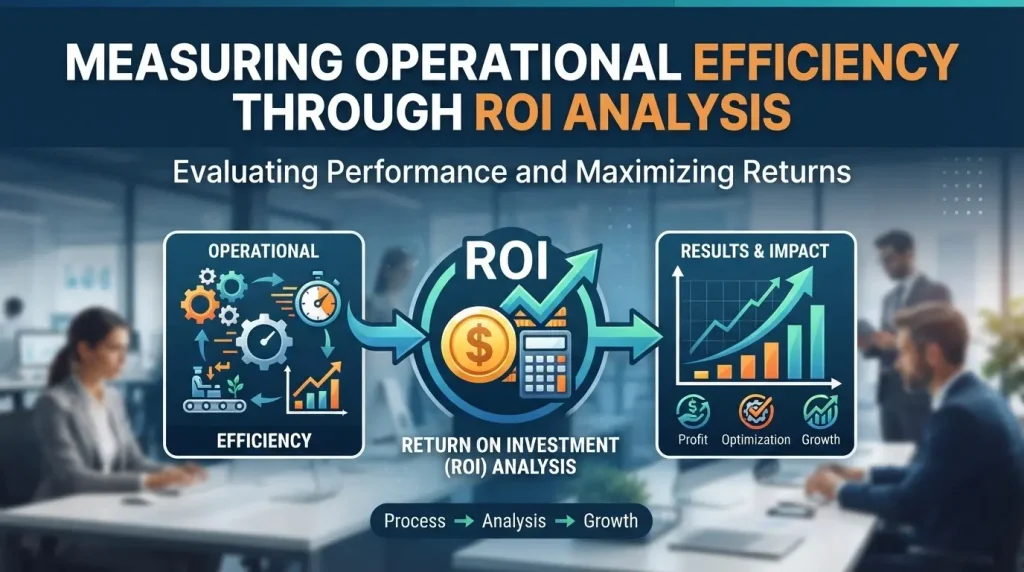 Business profitability depends not only on revenue generation but also on how efficiently organizations manage their daily operations. High operational expenses, inefficient workflows, and unnecessary resource consumption can reduce financial returns even when sales performance remains strong.
ROI Analysis helps businesses evaluate operational investments such as automation software, equipment upgrades, employee training, and process improvements. By comparing implementation costs with measurable financial benefits, organizations can determine whether operational changes justify their investment.
Evaluating Technology and Automation Investments
Technology investments can improve productivity, reduce manual workloads, and support faster business processes. However, organizations should evaluate software licensing, implementation expenses, maintenance costs, employee training, and potential productivity improvements before making purchasing decisions.
For example, a business implementing automated inventory software can compare its initial investment with reductions in manual labor, inventory errors, and stock management expenses. This helps management determine whether the technology produces sufficient financial benefits over time.
Reducing Operational Waste
Operational waste includes unnecessary expenses, duplicated activities, inefficient resource allocation, and avoidable process delays. Businesses can examine financial reports and operational performance data to identify areas where spending does not generate meaningful value.
Once these inefficiencies become visible, management can introduce process improvements and monitor their financial impact. Regular evaluation helps organizations maintain cost control without compromising product quality, employee performance, or customer satisfaction.
Common Challenges in ROI Analysis
Although ROI Analysis provides useful financial insights, businesses may experience difficulties when collecting accurate information or evaluating complex investments. Understanding these challenges helps organizations develop more reliable measurement processes and avoid misleading conclusions.
Incomplete or Inaccurate Financial Data
ROI calculations depend on accurate investment costs and financial returns. Missing expenses, incorrect revenue attribution, and inconsistent reporting periods can produce misleading results.
Organizations should establish standardized data collection procedures and include relevant direct and indirect costs wherever practical. Financial teams should also verify reporting information before using ROI results to support important investment decisions.
Difficulty Measuring Intangible Benefits
Some investments generate benefits that are difficult to express through immediate financial measurements. Brand awareness, employee satisfaction, customer trust, and improved organizational knowledge may contribute to long-term profitability without producing instant revenue.
Businesses should combine financial indicators with relevant nonfinancial performance measurements. This creates a more balanced evaluation of investments whose value extends beyond immediate financial returns.
Conclusion
ROI Analysis is an essential strategy for businesses that want to improve financial performance, manage investment costs, and maximize profitability. By evaluating investment returns, monitoring operational expenses, and identifying profitable opportunities, organizations can make more informed financial decisions.
Combining Business Intelligence, Marketing Intelligence, and Audience Segmentation provides additional insights into customer behavior, campaign effectiveness, and resource allocation. Businesses that regularly review their investment performance can identify inefficiencies, strengthen marketing strategies, and prioritize sustainable growth opportunities. Ultimately, a consistent and data-driven ROI strategy helps organizations use their financial resources more effectively and build long-term business profitability.
Frequently Asked Questions (FAQs)
1. What Is ROI Analysis in Business?
ROI Analysis is a financial evaluation method that measures the returns generated from an investment compared with its associated costs. Businesses use it to evaluate financial performance, compare investment opportunities, and identify activities that contribute to profitability.
2. Why Is ROI Analysis Important for Business Profitability?
ROI Analysis helps organizations understand whether their investments generate sufficient financial returns. It also identifies inefficient spending, supports better budget allocation, and helps management prioritize activities that contribute to sustainable business growth.
3. How Do You Calculate ROI?
ROI is calculated by subtracting the investment cost from the investment return, dividing the result by the investment cost, and multiplying by 100. The formula is ROI = [(Investment Return − Investment Cost) ÷ Investment Cost] × 100.
4. How Does Business Intelligence Improve ROI Analysis?
Business Intelligence improves ROI Analysis by organizing financial and operational information into meaningful reports. It helps organizations identify performance trends, evaluate investment outcomes, and make better decisions using reliable business data.
5. What Is the Role of Marketing Intelligence in ROI Analysis?
Marketing Intelligence provides information about campaign performance, customer preferences, competitor activities, and market trends. Businesses use these insights to evaluate marketing investments and identify strategies that generate stronger financial returns.
6. How Does Audience Segmentation Improve Marketing ROI?
Audience Segmentation helps businesses identify customer groups with different purchasing behaviors and profitability levels. Targeting relevant segments allows organizations to reduce unnecessary marketing expenses and improve campaign conversion performance.
7. What Is a Good ROI for a Business?
A good ROI depends on the industry, investment type, financial risk, and expected timeframe. Businesses should compare investment returns with industry benchmarks, alternative opportunities, and their own financial objectives rather than relying on one universal percentage.
8. How Often Should Businesses Perform ROI Analysis?
Businesses should perform ROI evaluations according to their investment cycles and reporting requirements. Marketing campaigns may require monthly reviews, while long-term technology investments may need quarterly or annual assessments to measure their full financial impact.
9. What Are the Common Challenges of ROI Analysis?
Common challenges include inaccurate financial data, incomplete cost calculations, attribution difficulties, and measuring intangible benefits. Establishing consistent reporting procedures and combining financial and nonfinancial indicators can improve the reliability of ROI evaluations.
10. Can ROI Analysis Help Small Businesses Grow?
Yes, ROI Analysis helps small businesses understand where their limited financial resources generate the greatest value. It supports better marketing decisions, cost management, investment planning, and resource allocation, allowing businesses to pursue sustainable growth.



Leave a Reply