

On the other hand, it’s difficult for businesses these days to cut through the noise and capture the attention of the digital prospect. But what, then, separates the leaders from the me-tooers? There is one particular approach that does stand out: data-driven marketing. Enterprises can develop personalized marketing approaches that are more attractive and deliver better returns by using customer data and analytics to better connect with the audience.
This blog provides information about the ins and outs of data-driven marketing. We’ll examine its advantages, the key features of an effective strategy, the tools you’ll require, and a sneak peek at what’s in store down the road.
What is Data-Driven Marketing?
At its essence, data-driven marketing is the process of employing insights derived from data to design and execute marketing activities. This may include studying user interactions, customer preferences, or market trends in order to make smart choices. Rather than playing a guessing game, marketing that’s driven by data is based on real, actionable insights.
For instance, rather than sending out email blasts to everyone, a company could analyze data that shows which groups of customers are likely to respond to certain promotions. The result? An alternative remedy and better results.
Advantages of Marketing Based on Data
Why does Your Business need to Buy In on Data-Driven Marketing?
The benefits may be greater than simply “knowing your audience.”
Improved Campaign Precision
Data takes the guesswork out of the equation. By knowing the demographics, likes, and shopping behavior of your customers, you can create specific-as-possible campaigns that appeal to them. For example, Netflix leverages viewer data to personalize recommendations for specific users, thereby increasing engagement.
Enhanced Customer Experiences
When companies understand customer data, they can optimize every interaction. This may refer to personalizing the offers within your email or the content you feature on your website that correlates with the interests of visitors. People love to be served as people, and data-inspired strategies enable you to do so.
Higher ROI
Targeted data campaigns are often cheaper. Why catch fewer numbers of bigger fish? When you can go for medium fish and know them better, you can hook them easier, and your ROI will increase.
Monitoring and Observability in Real-Time
Real-time analytics is generally available with most data-driven marketing tools. This, in turn lets you monitor the performance of your campaign in real-time and make adjustments if it’s not working. You don’t wait for campaign results — it’s like getting life-saving information in real time rather than days later.
Competitive Edge
Companies that do well with data frequently outperform those that don’t. By having no barriers between you and the market trends, you can beat the competition flat by giving the users what they want before they realise they need it in they’re hands.
The Role of Data-Driven Marketing in B2B Success
While consumer brands often grab the headlines for personalized ads, the impact of B2B data-driven marketing is just as profound, if not more critical, for long-term business growth. In the business-to-business landscape, sales cycles are longer, decision-making units are larger, and the stakes for each transaction are significantly higher. This complex environment makes intuition less reliable and data absolutely essential. By harnessing the power of data, B2B organizations can move beyond generic outreach and build sophisticated, high-touch relationships that drive revenue.
A successful data-driven marketing strategy in the B2B sector begins with precision targeting. Unlike B2C companies that might cast a wide net, B2B marketers need to identify specific accounts that fit their ideal customer profile. Data allows these teams to analyze firmographic details like company size, industry, and revenue, alongside technographic data that reveals what software a prospect is already using. When companies use data-driven marketing effectively, they can predict which prospects are ready to buy before a sales call even happens. This intent data transforms cold outreach into warm introductions, ensuring that sales teams spend their time on leads that have a genuine probability of converting.
Furthermore, data plays a pivotal role in nurturing these complex relationships over time. A B2B buyer rarely makes a purchase decision in isolation or on impulse. They require educational content, reassurance, and proof of value at various stages of their journey. Through data analysis, marketers can track how a prospect interacts with their brand across multiple touchpoints, from downloading whitepapers to attending webinars. This behavioral data provides a roadmap for personalization. Instead of sending a generic newsletter, a company can trigger an automated email sequence that addresses the specific pain points the prospect has shown interest in. This level of relevance builds trust and positions the vendor as a strategic partner rather than just another supplier.
The alignment between sales and marketing teams is another area where data proves indispensable. Historically, these two departments often operate in silos, with marketing generating leads that sales deems unqualified. Data bridges this gap by providing a single source of truth. When both teams have access to the same customer insights and agreed-upon metrics, they can collaborate more effectively. Marketing can refine their campaigns based on feedback from sales data, and sales can approach meetings armed with the detailed context provided by marketing analytics. This synergy shortens sales cycles and improves overall conversion rates.
Ultimately, the shift toward data-driven decision-making in B2B is about maximizing efficiency and relevance. In a crowded marketplace, buyers are overwhelmed by noise and generic pitches. They gravitate toward vendors who understand their specific challenges and offer tailored solutions. By leveraging data to gain a deep understanding of their audience, B2B companies can deliver the right message to the right decision-maker at exactly the right moment. This strategic approach not only enhances lead generation but also fosters loyalty, reducing churn and increasing the lifetime value of each client. As the digital landscape evolves, the B2B organizations that prioritize data will be the ones that secure a sustainable competitive advantage.
Steps to Build a Data-Driven Marketing Strategy
To create a successful data-driven marketing strategy, follow these steps:
-
Set Clear Objectives
- Define what you want to achieve, such as increased sales, better engagement, or improved customer retention.
-
Collect and Centralize Data
- Use tools like CRM software to gather data from multiple sources, including social media, email, and website analytics.
-
Segment Your Audience
- Group your audience based on demographics, behavior, or purchase history to create targeted campaigns.
-
Leverage Analytics Tools
- Use platforms like Google Analytics or Mixpanel to track campaign performance and gain actionable insights.
-
Personalize Campaigns
- Tailor your messaging and offers to individual customer preferences for a more engaging experience.
-
Test and Optimize
- Use A/B testing and real-time analytics to refine your strategy and improve results.
| Step | Description |
|---|---|
| Set Clear Objectives | Define measurable goals for your marketing efforts. |
| Collect Data | Gather data from various sources and centralize it in a CRM. |
| Segment Audience | Group customers based on shared characteristics for targeted campaigns. |
| Use Analytics Tools | Analyze performance metrics to identify areas for improvement. |
| Personalize Campaigns | Create tailored content and offers for individual customer segments. |
| Test and Optimize | Continuously refine your strategy using A/B testing and real-time feedback. |
There Are Elements of a Data-Driven Marketing Strategy
To fully harness the potential of data-driven marketing, businesses need more than just access to data. A successful strategy requires a structured approach that integrates data collection, segmentation, analysis, and personalization into a cohesive framework. Below, we’ll explore the key elements of a data-driven marketing strategy in greater detail, breaking down how each component contributes to creating impactful campaigns and driving business growth.
1. Data Collection
The foundation of any data-driven marketing strategy is robust data collection. Businesses must gather data from multiple sources to create a comprehensive view of their audience. These sources can include website analytics, social media interactions, email campaigns, customer surveys, transactional data, and even third-party data providers. For example, tools like Google Analytics can track user behavior on a website, while platforms like HubSpot or Salesforce can centralize customer interactions across various touchpoints.
However, collecting data is not just about quantity—it’s about quality. Businesses need to ensure that the data they gather is accurate, relevant, and up-to-date. This often involves implementing data validation processes and using tools that automatically clean and organize data. For instance, a CRM system can help eliminate duplicate entries and ensure that customer profiles are complete. By starting with clean, reliable data, businesses can avoid making decisions based on flawed or incomplete information.
2. Audience Segmentation
Once data is collected, the next step is to segment the audience into distinct groups based on shared characteristics. Segmentation allows businesses to tailor their marketing efforts to specific subsets of their audience, making campaigns more relevant and effective. Common segmentation criteria include demographics (age, gender, location), psychographics (interests, values, lifestyle), behavior (purchase history, website activity), and firmographics (company size, industry, revenue) for B2B marketing.
For example, an e-commerce retailer might segment its audience into categories like “frequent buyers,” “first-time visitors,” and “cart abandoners.” Each group would then receive targeted messaging designed to address their unique needs and behaviors. Frequent buyers might be offered loyalty rewards, while cart abandoners could receive a discount code to encourage them to complete their purchase. This level of precision ensures that marketing efforts resonate with the audience, leading to higher engagement and conversion rates.
3. Tracking and Analysis
Data collection and segmentation are only valuable if businesses actively track and analyze the performance of their campaigns. This involves using analytics tools to monitor key metrics such as click-through rates, conversion rates, bounce rates, and customer lifetime value. Platforms like Google Analytics, Adobe Analytics, and Mixpanel provide detailed insights into how users interact with a brand’s digital assets.
Real-time tracking is particularly important in today’s fast-paced marketing environment. By monitoring campaign performance in real time, businesses can identify what’s working and what’s not, allowing them to make adjustments on the fly. For instance, if an email campaign has a low open rate, marketers can test different subject lines or send times to improve results. This iterative approach ensures that campaigns are continuously optimized for maximum impact.
4. Personalization
Personalization is the cornerstone of data-driven marketing. By leveraging the insights gained from data collection and analysis, businesses can create highly tailored experiences for their customers. This can take many forms, from personalized email greetings and product recommendations to dynamic website content that adapts based on user behavior.
For example, streaming services like Netflix use data to recommend shows and movies based on a user’s viewing history. Similarly, e-commerce platforms like Amazon suggest products that align with a customer’s past purchases and browsing behavior. These personalized experiences not only enhance customer satisfaction but also drive loyalty and repeat business. In fact, studies show that consumers are more likely to engage with brands that offer personalized experiences.
5. Integration of Tools and Technologies
A successful data-driven marketing strategy relies on the seamless integration of various tools and technologies. CRM systems like Salesforce and HubSpot serve as the backbone for managing customer data, while analytics platforms provide the insights needed to inform decision-making. Marketing automation tools like Marketo and Mailchimp enable businesses to execute campaigns at scale, while social media management platforms like Hootsuite and Sprout Social help track performance across different channels.
The integration of these tools ensures that data flows smoothly between systems, creating a unified view of the customer. This eliminates silos and enables teams to collaborate more effectively. For example, marketing teams can use insights from sales data to refine their campaigns, while customer service teams can access detailed customer profiles to provide more personalized support.
6. Testing and Optimization
Finally, no data-driven marketing strategy is complete without a commitment to testing and optimization. A/B testing, in particular, is a powerful tool for identifying what resonates with an audience. By testing different variations of a campaign—such as email subject lines, ad creatives, or landing page designs—businesses can determine which version performs best and refine their approach accordingly.
Optimization is an ongoing process that requires constant monitoring and iteration. Real-time analytics play a crucial role here, allowing businesses to make data-driven decisions quickly. For example, if a social media ad is underperforming, marketers can adjust the targeting parameters or creative elements to improve results. This agile approach ensures that marketing efforts remain effective in a constantly changing landscape.
How Companies Use Data-Driven Marketing to Stay Competitive
 In an increasingly crowded digital landscape, understanding how companies use data-driven marketing is crucial for staying ahead of the curve. It is no longer enough to rely on intuition or broad demographic assumptions. Today, successful brands leverage granular data to craft hyper-personalized experiences that resonate deeply with individual consumers. This shift represents a fundamental change in how businesses operate, moving from a product-centric approach to a customer-centric one. By analyzing vast amounts of information, organizations can uncover hidden patterns and preferences that allow them to anticipate customer needs before they are even expressed. This proactive stance is what separates market leaders from those struggling to keep up.
One of the most powerful applications of a robust data-driven marketing strategy is the ability to deliver personalized customer experiences at scale. Consider how streaming services or e-commerce giants operate. They do not merely present a static library of products; they curate dynamic, individualized homepages for millions of users simultaneously. By tracking viewing habits, purchase history, and browsing behavior, these platforms can suggest the exact content or product a user is likely to want next. This level of personalization fosters a sense of being understood, which significantly boosts customer loyalty and lifetime value. When a brand consistently delivers relevant recommendations, it transforms a simple transaction into a meaningful relationship.
Beyond personalization, predictive analytics has emerged as a game-changer for forward-thinking enterprises. Instead of reacting to past sales data, companies now use sophisticated algorithms to forecast future trends. This allows marketing teams to allocate budgets more efficiently and launch campaigns with higher confidence. For instance, a retailer might use weather patterns and historical sales data to predict a surge in demand for winter coats in a specific region, launching targeted ads weeks before the first snowfall. This foresight ensures that marketing efforts are not just timely but also highly relevant, minimizing wasted ad spend and maximizing return on investment. It serves as a practical data-driven marketing guide for businesses looking to optimize their resources.
Real-time campaign optimization is another critical area where data proves its worth. In the past, marketers would launch a campaign and wait weeks to analyze its performance. Today, live data streams allow for immediate adjustments. If a particular ad creative is underperforming on social media, algorithms can automatically shift the budget to a better-performing variation within minutes. This agility ensures that every dollar spent is working as hard as possible. Companies use data-driven marketing not just to plan, but to react and adapt in the moment, seizing opportunities that would otherwise be lost.
Ultimately, the competitive advantage lies in the ability to turn raw numbers into actionable insights. It is not just about collecting data; it is about interpreting it to make smarter decisions. Whether it is through refining audience segmentation, improving customer retention strategies, or innovating new product lines based on feedback loops, data is the fuel that powers modern business growth. As technology continues to evolve, the organizations that prioritize a data-first mindset will be the ones that thrive, while those that ignore the signals will find themselves left behind in a rapidly changing marketplace.
Data-Driven Marketing Tools and Technologies
In the modern marketing landscape, data-driven strategies are only as effective as the tools and technologies that power them. These tools enable businesses to collect, analyze, and act on data to create personalized, impactful campaigns. From customer relationship management (CRM) systems to advanced artificial intelligence (AI) solutions, the right technologies can transform raw data into actionable insights. Below, we’ll explore the essential tools and technologies that form the backbone of a successful data-driven marketing strategy.
1. Customer Relationship Management (CRM) Software
CRM software is the cornerstone of data-driven marketing. Tools like Salesforce, HubSpot, and Zoho CRM allow businesses to centralize customer data, track interactions, and manage relationships across the entire customer lifecycle. These platforms provide a unified view of each customer, consolidating data from various touchpoints such as email, social media, and website interactions.
For example, a CRM system can track when a customer opens an email, clicks on a link, or makes a purchase. This data can then be used to create personalized marketing campaigns tailored to the customer’s preferences and behavior. Additionally, CRM tools often include automation features, such as sending follow-up emails or reminders, which save time and ensure consistent communication.
2. Analytics Platforms
Analytics platforms are essential for tracking and measuring the performance of marketing campaigns. Tools like Google Analytics, Adobe Analytics, and Mixpanel provide detailed insights into user behavior, website traffic, and conversion rates. These platforms help marketers understand what’s working and what needs improvement.
For instance, Google Analytics can show which pages on a website have the highest bounce rates, allowing marketers to identify areas that need optimization. Adobe Analytics, on the other hand, offers advanced segmentation and predictive analytics capabilities, enabling businesses to forecast future trends and make data-driven decisions. By leveraging these insights, marketers can refine their strategies to maximize ROI.
3. Marketing Automation Tools
Marketing automation tools like Marketo, Mailchimp, and ActiveCampaign streamline repetitive tasks and enable personalized outreach at scale. These platforms allow businesses to automate email campaigns, social media posts, and lead nurturing workflows, freeing up time for more strategic activities.
For example, a marketing automation tool can segment an email list based on user behavior, such as past purchases or website visits, and send targeted messages to each segment. This level of personalization increases engagement and improves conversion rates. Additionally, automation tools often include A/B testing features, allowing marketers to experiment with different campaign elements and optimize for better results.
4. Social Media Management Tools
Social media is a critical channel for data-driven marketing, and tools like Hootsuite, Sprout Social, and Buffer make it easier to manage and analyze social media campaigns. These platforms allow businesses to schedule posts, monitor engagement, and track performance metrics across multiple social networks.
For example, Hootsuite provides a dashboard where marketers can view all their social media accounts in one place, making it easy to track likes, shares, and comments. Sprout Social goes a step further by offering audience insights and sentiment analysis, helping businesses understand how their content resonates with their audience. By using these tools, marketers can fine-tune their social media strategies to drive better results.
5. Artificial Intelligence (AI) and Machine Learning
AI and machine learning are revolutionizing data-driven marketing by enabling predictive analytics, real-time personalization, and advanced customer insights. Tools like Jasper, Salesforce Einstein, and IBM Watson use AI to analyze large datasets and uncover patterns that would be impossible for humans to detect.
For example, AI-powered tools can predict which customers are most likely to churn and recommend actions to retain them. They can also personalize website content in real time based on a user’s browsing history, creating a more engaging experience. Additionally, AI can automate tasks like content creation and ad targeting, allowing marketers to focus on strategy rather than execution.
6. Data Visualization Tools
Data visualization tools like Tableau, Power BI, and Google Data Studio help marketers make sense of complex data by presenting it in an easy-to-understand format. These tools allow businesses to create interactive dashboards and reports that highlight key metrics and trends.
For instance, Tableau can visualize customer journey data, showing how users move through a website and where they drop off. Power BI can integrate data from multiple sources, such as CRM systems and analytics platforms, to provide a holistic view of marketing performance. By using these tools, marketers can communicate insights more effectively and make informed decisions.
7. Customer Data Platforms (CDPs)
Customer Data Platforms like Segment, BlueConic, and Tealium are designed to unify customer data from various sources into a single, comprehensive profile. Unlike CRMs, which focus on managing customer relationships, CDPs are specifically built for data integration and analysis.
For example, a CDP can combine data from a company’s website, mobile app, and email campaigns to create a 360-degree view of each customer. This unified data can then be used to deliver personalized experiences across all channels. CDPs also enable real-time data activation, allowing businesses to respond to customer actions as they happen.
8. Predictive Analytics Tools
Predictive analytics tools like SAS, RapidMiner, and Alteryx use machine learning algorithms to forecast future trends and customer behavior. These tools help businesses allocate resources more effectively and plan campaigns with greater confidence.
For example, a retailer might use predictive analytics to identify which products are likely to be popular during the holiday season and adjust their inventory and marketing efforts accordingly. By anticipating customer needs, businesses can stay ahead of the competition and deliver more relevant experiences.
Using Data to Drive Your Market Strategy
In today’s competitive landscape, data is the fuel that powers effective marketing strategies. Transitioning to a data-driven approach requires careful planning, but the rewards are well worth the effort. By leveraging data, businesses can make informed decisions, create personalized campaigns, and achieve better results. Here’s how to use data to drive your market strategy effectively.
1. Set Clear Goals
The first step in a data-driven strategy is defining clear, measurable objectives. Whether your goal is to increase conversions, improve customer retention, or boost engagement, having a specific target ensures that your efforts are focused. For example, instead of aiming to “increase sales,” set a goal like “achieve a 20% increase in online sales within three months.” Clear goals provide a benchmark for success and guide your data collection and analysis efforts.
2. Gather and Centralize Data
Data is often scattered across multiple platforms, from social media and email campaigns to website analytics and CRM systems. Centralizing this data in one place, such as a CRM or customer data platform (CDP), creates a unified view of your audience. This consolidation allows you to identify patterns, track customer behavior, and uncover actionable insights. For instance, analyzing website traffic alongside email open rates can reveal which campaigns drive the most engagement.
3. Invest in Training and Tools
To fully utilize data, your team needs the right skills and tools. Invest in training programs to help employees interpret data and make data-driven decisions. Equip your team with tools like Google Analytics, Tableau, or marketing automation platforms to streamline processes and gain deeper insights.
4. Start Small and Optimize
Begin with small-scale campaigns to test your data-driven approach. Use A/B testing and real-time analytics to refine your strategy, ensuring continuous improvement. Over time, scale your efforts to maximize impact and ROI.
Data-Driven Marketing Challenges and Solutions
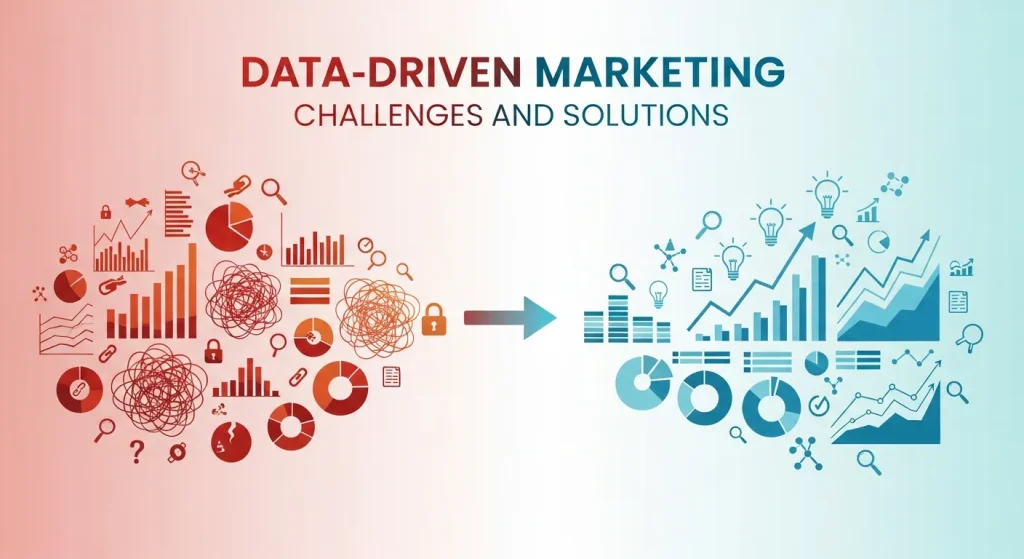 While data-driven marketing offers immense potential, it is not without its challenges. Businesses often face obstacles related to data privacy, information overload, and system integration. However, with the right strategies, these challenges can be effectively addressed. Here’s a closer look at the common hurdles and their solutions.
1. Data Privacy and Compliance
One of the biggest challenges in data-driven marketing is ensuring compliance with data privacy regulations like GDPR, CCPA, and other global standards. Consumers are increasingly concerned about how their data is collected, stored, and used. Failing to comply with these regulations can lead to hefty fines and damage to a brand’s reputation.
Solution: Businesses must adopt transparent data practices, clearly communicate how customer data is used, and obtain explicit consent. Implementing secure data storage systems and regular audits ensures compliance. Additionally, anonymizing data and using aggregated insights can help maintain privacy while still leveraging valuable information.
2. Information Overload
With the vast amount of data available, businesses often struggle to identify actionable insights. Too much data can lead to analysis paralysis, where teams are overwhelmed and unable to make decisions.
Solution: Focus on collecting and analyzing only the most relevant data. Use tools like dashboards and data visualization platforms (e.g., Tableau, Power BI) to simplify complex datasets. Prioritize key performance indicators (KPIs) that align with your business goals to avoid distractions.
3. Integration Issues
Many businesses face difficulties integrating new tools with existing systems, leading to data silos and inefficiencies.
Solution: Invest in platforms that offer seamless integration, such as customer data platforms (CDPs) or APIs. Ensure that all tools in your tech stack communicate effectively to create a unified view of customer data.
By addressing these challenges, businesses can unlock the full potential of data-driven marketing and stay ahead in a competitive landscape.
Unlock Your Marketing Buttons
Fueled by data, being data-driven is no longer a marketing choice; it’s a requirement. Businesses that capitalise on data insights for their marketing will get better results and build deeper customer relationships.
Now, are you brave enough to take the plunge? Begin using data-driven marketing to remain connected and competitive.
Future Trends in Data-Driven Marketing
The future of data-driven marketing is shaped by advancements in technology and changing consumer expectations. Here’s what to expect:
-
Predictive Analytics
- AI-powered tools will enable businesses to predict customer behavior and preferences with greater accuracy.
-
Hyper-Personalization
- Real-time data will allow for even more tailored customer experiences, from personalized emails to dynamic website content.
-
Voice and Visual Search
- As voice and visual search grow in popularity, marketers will need to optimize their strategies for these formats.
-
Privacy-First Marketing
- With stricter data privacy regulations, businesses will need to adopt transparent and ethical data practices.
-
Integration of IoT Data
- The Internet of Things (IoT) will provide new data sources, enabling deeper insights into customer behavior.
| Trend | Impact on Marketing |
|---|---|
| Predictive Analytics | Enables proactive decision-making and better targeting. |
| Hyper-Personalization | Delivers highly relevant and engaging customer experiences. |
| Voice and Visual Search | Requires optimization for new search formats to stay competitive. |
| Privacy-First Marketing | Builds trust and ensures compliance with data protection laws. |
| IoT Data Integration | Provides richer insights into customer behavior and preferences. |
These trends highlight the importance of staying ahead in the ever-evolving landscape of data-driven marketing.
Frequently Asked Questions (FAQs)
1. What is data-driven marketing?
Data-driven marketing is the use of customer data and analytics to create personalized marketing strategies. It helps businesses make informed decisions and connect better with their target audience.
2. Why is data-driven marketing important?
Data-driven marketing improves campaign precision, enhances customer experiences, increases ROI, and provides real-time insights. It helps businesses stay competitive by delivering personalized and relevant content to their audience.
3. What tools are essential for data-driven marketing?
Key tools include CRM software (e.g., Salesforce, HubSpot), analytics platforms (e.g., Google Analytics), marketing automation tools, social media management tools, and AI-powered solutions like Jasper for predictive insights.
4. How does data-driven marketing improve ROI?
By targeting specific audience segments with personalized campaigns, businesses reduce wasted resources and increase engagement, leading to higher conversion rates and better returns on investment.
5. What are the challenges of data-driven marketing?
Challenges include data privacy compliance (e.g., GDPR), managing information overload, and integrating new tools with existing systems. Addressing these issues requires careful planning and investment in the right technologies.
6. How can small businesses adopt data-driven marketing?
Small businesses can start by setting clear goals, centralizing data in a CRM, using affordable analytics tools, and running small-scale campaigns to test and refine their strategies.
7. What role does AI play in data-driven marketing?
AI enables predictive analytics, real-time personalization, and automation of marketing tasks. It helps businesses analyze large datasets and deliver tailored experiences at scale.
8. How can businesses ensure data privacy in marketing?
Businesses should comply with regulations like GDPR, be transparent about data usage, and implement secure data storage practices to build trust with their customers.
9. What industries benefit most from data-driven marketing?
Industries like e-commerce, B2B, healthcare, and entertainment benefit significantly from data-driven marketing by leveraging customer insights to create personalized and effective campaigns.
10. How can businesses measure the success of data-driven marketing?
Success can be measured using key performance indicators (KPIs) like conversion rates, customer engagement, ROI, and campaign performance metrics tracked through analytics tools.



Leave a Reply