

The great desires of most consumers today are for personalized products and services, and for businesses, the race to provide is in full flow. But what really allows brands to know what their audience likes, does, and needs? The answer lies in data. Data-driven digital marketing is the not-so-secret weapon smart marketers use to plan, pre-launch, and execute their most effective strategies using concrete numbers, not guesswork.
We’ll venture into what data-driven digital marketing is, the fundamental principles and advantages of such a method, unveil some helpful strategies, and get actionable tips on tools you can use, challenges you will meet, and what the future of data-driven digital marketing will be like.
Data-Driven Digital Marketing Defined
At its most basic, data-driven digital marketing is creating campaigns based on data. Throughout this process of gathering, analyzing, and using data concerning how your audience acts, what they like, and how you interact with them, you are in a position to develop very targeted strategies that produce measurable outcomes.
This is a total contrast to the old ways of marketing in which companies could only hypothesize about what customers wanted or act based on trends. It enables marketers to deliver the right message, in the right place, at the right time.
For instance, Amazon’s recommendation engine relies on the customer’s purchase and browsing history to propose products according to individual preferences. That is data-driven marketing in practice.
The Building Blocks of Data-Driven Marketing
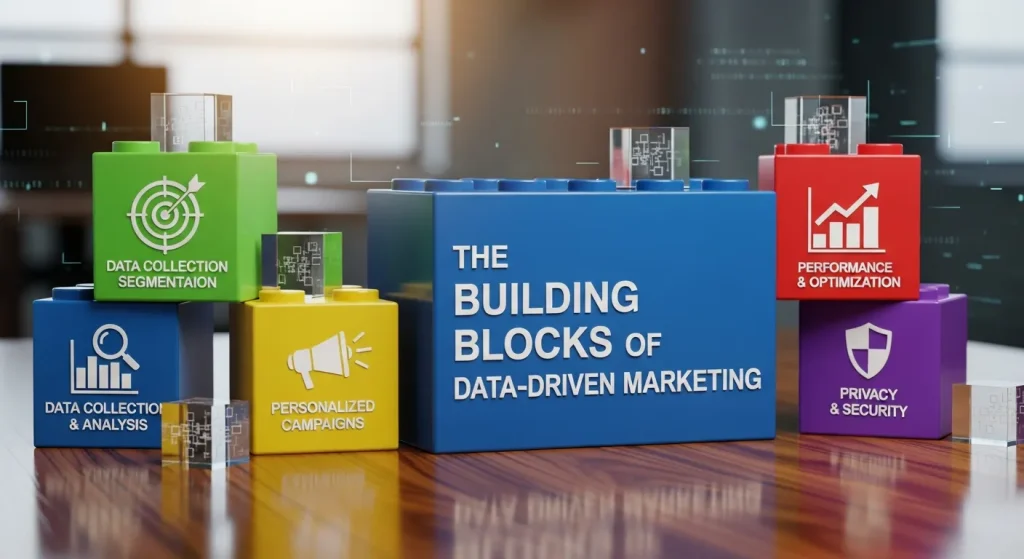
Getting to know the basics of data-driven marketing will help you develop a successful campaign. This approach is guided by these principles:
Data Collection
Every effective data-driven plan starts with good data collection. This might be web-page analytics, social media engagement, email click-throughs, or reports from 3rd-parties. Google Analytics, HubSpot, and social media insights are tools necessary for this endeavor.
Data Analysis
Data collection is of no use if the data is not analyzed. Through trend monitoring, pattern recognition, and identifying customer desires, Analytics turn raw data into actionable insight.
Audience Segmentation
Not all customers are equal. Segmentation Segmenting is the process of breaking your contacts into smaller groups of people, typically by some combination of demographics, behaviors, or preferences, so you can tailor your campaigns for them in a more personalized way.
Personalization
The modern consumer is demanding that brands speak to them directly. Personalization takes advantage of the data generated by audience segmentation to design unique experiences, from targeted ads to personal emails.
Performance Measurement
No data-driven marketers will have their work cut out for them. But KPIs, like ROI, clicks, CTR, and customer acquisition cost, guarantee they focus on performance and adapt in real time.
Advantages of Data
Marketing-led enterprises are often more successful than those that aren’t.
The benefits of using data-driven digital marketing are more than just happier customers. Here’s why businesses should think about it:
- Informed Decision Making: Data brings transparency and eliminates speculations, leading to intelligent and timely business decisions.
- Better ROI: By employing customized campaigns, budgets are more efficiently utilized, resulting in higher returns.
- Customer Personal Touch: Treat your customers genuinely to were your own. “Data is enabling brands to provide exactly what customers desire,” said Jason Heller, head of the digital marketing practice in North America at McKinsey.
- Actionable Insights: Enterprises receive detailed information about their audience to remain ahead of their competition.
Building a Successful B2B Data-Driven Marketing Strategy
While the principles of data-driven marketing apply universally, a B2B data-driven marketing strategy requires a distinct approach compared to B2C. The sales cycles are longer, decision-making involves multiple stakeholders, and the data points are often more complex. Success hinges on a nuanced strategy that prioritizes lead quality over quantity and nurtures relationships over extended periods. A solid plan involves several key stages, from identifying the right accounts to delivering highly personalized content that addresses specific business challenges.
To build an effective strategy, you must align your sales and marketing teams around common goals and data points. This alignment, often called “smarketing,” ensures a seamless transition for leads as they move through the funnel.
Key components of a B2B strategy include:
- Account-Based Marketing (ABM): Focus your marketing efforts on a select group of high-value target accounts. Use data to identify companies that fit your ideal customer profile (ICP) based on firmographics like industry, company size, revenue, and technology stack.
- Lead Scoring: Develop a lead scoring model that uses behavioral and demographic data to rank leads. This helps your sales team prioritize their efforts on prospects who are most likely to convert, making the sales process more efficient.
- Content Personalization: Go beyond using a prospect’s name. Create content tailored to their industry, role, and stage in the buyer’s journey. For example, a CTO at a target account might receive a whitepaper on technology integration, while a marketing manager gets a case study on campaign ROI.
- Predictive Analytics: Implement predictive models to forecast which accounts are most likely to purchase. This forward-looking approach allows you to proactively engage potential clients before they even begin their active search, giving you a competitive edge.
Comparing Data-Driven Marketing Metrics Across Channels
A core tenet of any data-driven marketing guide is the consistent measurement of performance. However, the key performance indicators (KPIs) you track can vary significantly depending on the channel you are using. Understanding which metrics matter most for each platform is crucial for optimizing your campaigns and allocating your budget effectively. For instance, the metrics that define success for an email campaign are very different from those for a social media or SEO initiative.
A holistic data-driven marketing strategy integrates insights from all channels to paint a complete picture of the customer journey. By analyzing how users interact across different touchpoints, you can make more informed decisions. For example, you might discover that a specific blog post (SEO) drives a high volume of email newsletter sign-ups (Email Marketing), which in turn leads to a high conversion rate on a targeted ad campaign (Social Media). The table below outlines primary and secondary KPIs for some of the most common digital marketing channels.
|
Channel |
Primary KPIs |
Secondary KPIs |
|---|---|---|
|
Email Marketing |
Open Rate, Click-Through Rate (CTR), Conversion Rate |
Unsubscribe Rate, Bounce Rate, List Growth Rate |
|
Social Media |
Engagement Rate (likes, comments, shares), Reach, Conversions |
Follower Growth, Click-Through Rate (CTR), Brand Mentions |
|
SEO |
Organic Traffic, Keyword Rankings, Backlinks |
Bounce Rate, Pages per Session, Time on Page |
|
PPC Advertising |
Cost Per Click (CPC), Conversion Rate, Return on Ad Spend (ROAS) |
Click-Through Rate (CTR), Quality Score, Impression Share |
|
Content Marketing |
Page Views, Time on Page, Downloads (e.g., ebooks) |
Social Shares, Backlinks, New vs. Returning Visitors |
Crucial Approaches for Success in Data-Driven
If using data is key to success, there are certain strategies that companies must undertake:
Set Clear Objectives
Determine measurable goals like 20% more website traffic or increased email conversion rates. Your campaigns are only as strong as your marketing team’s ability to connect the dots and work together.
Use Predictive Analytics
Predictive analytics uses historical patterns to predict future behavior. Netflix, for example, harnesses predictive models to suggest shows that its users are likely to watch.
Leverage Retargeting
And those abandoned carts or unclicked emails? That data can be utilized to retarget customers with personal advertisements or exclusive discounts.
A/B Testing
Decide to be an experimenter in your data-driven marketing. A/B testing aids in maximizing things such as headlines, email content, and ad images for better performance.
Embrace Multi-Channel Marketing
A strong social media marketing strategy is closely tied to other types of media marketing, including email, print, and advertising. Users engage via a variety of touchpoints. Build with data, well-rounded marketing campaigns across social media, email, web, and in-store experiences.
Data Analysis Tools and Technologies
The right tools can revolutionize your data-driven marketing approach. Here are a few potent platforms to consider:
- Google Analytics: Provides comprehensive statistics regarding web traffic, user behavior, and demographics, among others.
- HubSpot: Unifies analytics, CRM, and marketing automation into a single cohesive strategy.
- Tableau: A tool for data visualization that transforms raw data into easy-to-understand visuals.
- SEMRush: Great for evaluating SEO campaigns and chasing down the competition.
- Power BI: A good tool for marketers to collect data from different sources and create insightful reports.
Case Studies and Real World Examples

Spotify’s Wrapped Campaign
Spotify relies on listening data to build its popular year-end “Wrapped” feature, which delivers users personalized summaries of their listening habits. The initiative successfully cultivates user loyalty, as well as garnering viral attention each year.
Coca-Cola’s AI Marketing
Coca-Cola uses AI and data from consumers to create super-personalized campaigns, which results in higher engagement and revenue.
Starbucks’ Loyalty Program
Starbucks also tracks what kinds of customers are redeeming the coupons. This tactic breeds customer loyalty and repeat business.
Challenges and Solutions
Data-driven marketing is rewarding, but it is accompanied by common challenges:
- Data Privacy Regulations: It can be tricky to navigate privacy laws (& responsibilities like GDPR, CCPA, etc.).
Solution: Transparency first: Invest in compliant tools. - Incomplete Sets of Data: Incomplete data can bias conclusions.
Solution: Leverage applications that bring in multiple data streams to provide coverage. - Excessive Trust in Tools: Tools are necessary, but human oversight is crucial to prevent over-automation.
- Integration Challenges: Integrating data across multiple platforms is not an easy feat.
Solution: Use centralized tools such as CRM to keep your data in one place.
What the Future Holds for Data-Driven Digital Marketing
The future of data-driven marketing is promising, driven by technology transformation and customer expectations:
- AI Will Lead Personalization to Uber-Personal Campaigns: With AI integration, personalization will be brought to new heights through hyper-personalized campaigns.
- Real Time Analytics: Powerful tools that will give you immediate insights for even more agile marketing tactics.
- Optimization for Voice Searches: In the age of voice-controlled virtual assistants, you’ll need to optimize for spoken questions.
- Responsible Marketing: Companies must responsibly collect and use information to establish trust with their audience.
Change How You Market with Data
Today, any serious business looking to succeed in a competitive marketplace can no longer do without data-driven digital marketing. Data opens the door to your marketing opportunities. Whether it’s sending a customized marketing campaign or decision-making, data is your answer to unlocking your marketing potential.
Begin your marketing evolution as a business with the proper tools and tactics. Curious to learn more? See what innovative platforms can do for your marketing.
Frequently Asked Questions (FAQs)
1. What is the first step in creating a data-driven marketing strategy?
The first step is always to define clear and measurable objectives. Before you collect any data, you must know what you want to achieve, whether it’s increasing website traffic, improving lead quality, or boosting customer retention. These goals will guide your entire data-driven marketing strategy.
2. How can small businesses with limited budgets use data-driven marketing?
Small businesses can start by using free tools like Google Analytics to understand website traffic and user behavior. They can also leverage the built-in analytics on social media platforms to gain audience insights. The key is to start small, focus on high-impact data, and scale efforts gradually.
3. What is the difference between data analytics and data-driven marketing?
Data analytics is the process of examining raw data to find trends and draw conclusions. Data-driven marketing is the application of those conclusions, using the insights gained from analytics to plan, execute, and refine marketing campaigns for better performance and personalization.
4. Why is audience segmentation important in a data-driven marketing guide?
Audience segmentation is crucial because it allows you to move beyond one-size-fits-all messaging. By grouping your audience based on demographics, behaviors, or preferences, you can deliver highly relevant and personalized content that resonates more deeply and drives better results.
5. How do companies use data-driven marketing to improve customer experience?
Companies use data-driven marketing to understand customer pain points and preferences. For example, analyzing purchase history and browsing behavior allows e-commerce sites like Amazon to recommend products you’ll actually like, creating a smoother and more personalized shopping experience.
6. What are the main challenges of implementing a B2B data-driven marketing plan?
The main challenges in B2B data-driven marketing include dealing with long sales cycles, integrating data from various platforms like a CRM and marketing automation tool, and ensuring data accuracy across a smaller, high-value audience. Getting buy-in from both sales and marketing is also critical.
7. Can data-driven marketing feel too intrusive to customers?
It can if not handled responsibly. The key is to use data to provide value, not just to sell. Transparency is vital. When customers feel you are using their data to offer relevant solutions and a better experience, they are more likely to respond positively.
8. What role does artificial intelligence (AI) play in data-driven marketing?
AI supercharges data-driven marketing by automating complex analysis and enabling hyper-personalization at scale. AI algorithms can predict customer behavior, optimize ad spend in real-time, and generate dynamic content tailored to individual users, making campaigns more efficient and effective.
9. How is ROI measured in a data-driven marketing campaign?
Return on Investment (ROI) is measured by comparing the revenue generated from a campaign against its total cost. With a data-driven approach, you can track conversions precisely, attribute them to specific channels, and calculate a clear ROI, proving the value of your marketing efforts.
10. How often should I analyze my marketing data?
The frequency of analysis depends on the channel and campaign. For fast-moving channels like social media or PPC ads, daily or weekly analysis is beneficial. For longer-term strategies like SEO or content marketing, monthly or quarterly reviews are often more practical and insightful.



Leave a Reply