

Understanding Inbound Marketing is a customer-focused, data-driven approach that attracts, engages, and delights audiences through valuable content and personalized experiences. By building trust and nurturing long-term relationships, businesses can generate qualified leads and drive conversions. Using SEO, social media, email campaigns, and analytics, understanding inbound marketing helps companies achieve sustainable growth and strengthen brand loyalty.
What is Inbound Marketing?
Inbound Marketing is a customer-centric, data-driven approach to marketing that businesses use to attract potential customers into their sales funnel. Compared to typical “outbound” marketing strategies, which involve reaching out to consumers whether they want to hear from you or not (cold calls, spam emails, and interruptive ads), inbound draws interested customers to your product or service and keeps them coming back for more.
Inbound marketing helps to create trust and long-term relationships with your audience by meeting them where they are already spending time: in the online world.
Core Concepts of the Inbound Methodology
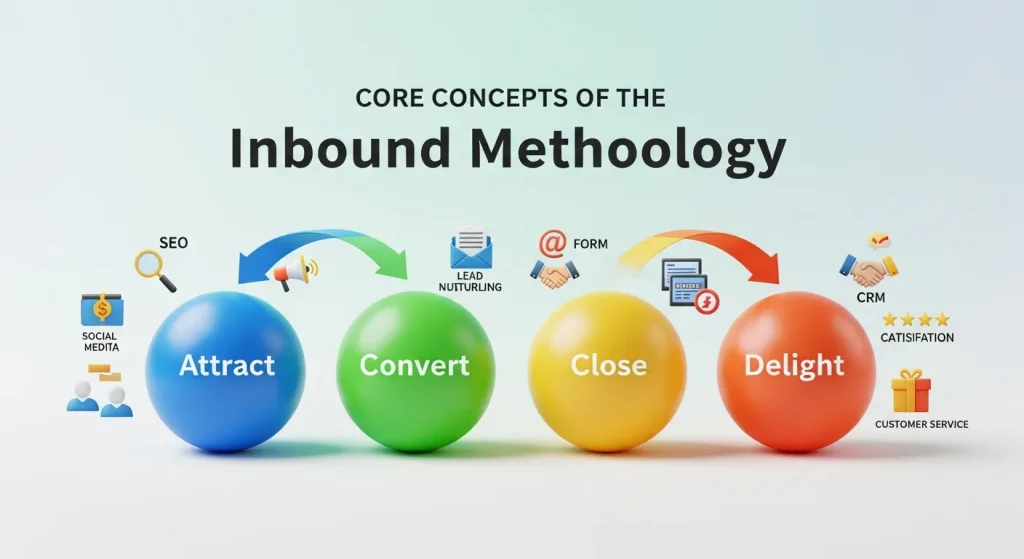
Inbound marketing principles | Inbound marketing meaning
To truly understand inbound marketing, it is important to explore the core principles that shape this approach. Inbound marketing is built on creating meaningful connections with the right audience by delivering value at every stage of their journey. Rather than interrupting people with unwanted promotions, it focuses on attracting individuals who are already searching for solutions, guiding them with helpful content, and building lasting relationships through trust and relevance.
Attract
The first stage of inbound marketing is attracting the right audience to your brand. This involves creating and sharing high-quality, informative, and engaging content that speaks directly to your ideal customers’ interests and challenges. Businesses use strategies such as blogging, search engine optimization (SEO), educational resources, and social media to increase visibility and bring in visitors who are genuinely interested in what they offer. The goal is not just traffic, but the right traffic—people who are more likely to engage and eventually convert. Learn how data improves targeting in data-driven marketing strategies.
Engage
Once you have captured your audience’s attention, the next step is engagement. This stage focuses on building trust by offering personalized solutions and meaningful interactions. Businesses nurture potential customers through tailored email campaigns, helpful resources, interactive tools, and responsive communication. By understanding individual needs and providing relevant guidance, brands position themselves as trusted advisors rather than just sellers, making customers more comfortable moving forward in their journey.
Delight
The final stage is delight, where businesses strengthen relationships and turn customers into loyal advocates. This goes beyond completing a sale—it involves delivering consistent value and exceptional experiences even after the purchase. Companies achieve this through outstanding customer support, loyalty programs, personalized follow-ups, and continuous delivery of useful content. When customers feel valued and supported, they are more likely to return, recommend the brand, and build long-term loyalty.
The Transformative Power of Inbound Marketing for Businesses
Inbound marketing stands out because it prioritizes long-term relationships and meaningful engagement over quick, one-time sales. This approach creates a sustainable growth model that benefits businesses across industries and sizes.
Builds Trust and Credibility
Modern consumers are more informed and selective than ever before. They tend to avoid aggressive advertising and instead seek reliable sources that provide genuine value. Inbound marketing helps businesses establish authority by consistently sharing helpful, educational, and relevant content. Over time, this positions the brand as a trusted expert in its field, making customers more confident in choosing its products or services.
Cost-effective
Compared to traditional outbound marketing, inbound marketing often delivers a stronger return on investment. Since it targets people who are already interested, the leads generated are typically more qualified and easier to convert. Additionally, inbound strategies can be scaled according to budget, allowing businesses to grow sustainably without overspending. Well-optimized content can continue generating traffic and leads long after it is published, increasing long-term marketing efficiency.
Targeted Reach
Inbound marketing focuses on reaching the right audience at the right time using analytics, behavior tracking, and customer insights. Discover how brands leverage insights in marketing driven by consumer data. By using data-driven strategies such as SEO, behavioral tracking, and analytics, businesses can understand customer intent and deliver content that matches their needs. This ensures that marketing messages resonate with users who are already searching for solutions, increasing engagement and improving conversion potential.
Sustainable Growth
Unlike outbound campaigns that stop producing results once the budget runs out, inbound marketing builds a long-lasting foundation. Quality content, optimized websites, and strong customer relationships continue to attract visitors, generate leads, and drive conversions over time. This creates a steady and sustainable growth cycle where businesses benefit from ongoing visibility, trust, and engagement.
How Inbound Marketing Works
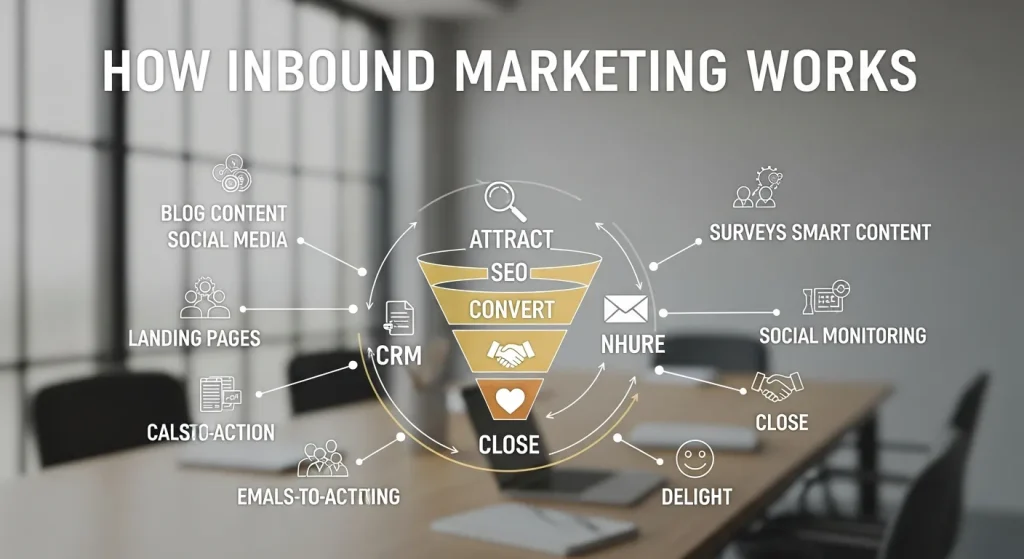 Successful inbound marketing is achieved through a combination of methods and tools that attract, engage, and delight. So let’s examine a few of the most effective strategies utilized below.
Content Creation
Content is the workhorse of inbound marketing. Creating useful blogs, videos, and resources helps solve audience pain points and attract customers organically. Learn more about building effective resources in data-driven content marketing. Whether it’s through blog posts, videos, infographics, or podcasts, developing compelling and informative content to address your audience’s pain points and bring customers to your site. Find those pain points in any industry and then build resources that provide solutions.
Search Engine Optimization (SEO)
Nobody cares about your content if it doesn’t reach the right person. SEO enhances your web pages for keywords so that potential customers can find you and find you on search engines like Google.
Social Media Marketing
Through platforms such as Instagram, Facebook, and LinkedIn, you can tell the story of your brand and drive potential customers to your products. Social media marketing extends the reach of your content and brings you closer to your users to form a more personal relationship where you earn trust, which is crucial to building brand loyalty.
Email Marketing
Once users interact with your site, learn how to grow the relationship with an email campaign. Segmented emails according to user preferences, behavior, or purchase history, keeping businesses relevant and top of mind.
Landing Pages and Lead Generation
Inbound Marketers use landing pages in combination with calls-to-action to convert visitors into leads. For example, a good offer, such as a free ebook or a sneak preview of a service, might be all that it takes to get a user to enter their email address.
Customer Reviews and Analytics
Continual refining of your strategies requires collecting insights on how your customers behave, react, and respond—often through analytical tools and performance tracking. With platforms like Google Analytics or advanced CRM software, businesses can monitor progress and make data-driven adjustments—learn more in mastering data analysis guide
Inbound Marketing Success Stories
 Still unsure whether inbound marketing is the right strategy for your business? Looking at real-world examples can make its impact much clearer. Many globally recognized brands have successfully used inbound marketing to attract audiences, build trust, and drive long-term growth. Below are a few notable examples.
HubSpot
HubSpot is widely recognized as one of the pioneers of inbound marketing and has played a major role in shaping how businesses approach customer engagement today. Instead of relying on aggressive promotion, HubSpot focused on educating its audience through valuable content. By creating an extensive library of blogs, ebooks, webinars, certification courses, and free tools, the company positioned itself as a trusted resource for marketers and businesses worldwide. This value-first approach not only attracted millions of users but also built strong brand authority and loyalty, proving how powerful educational content can be in driving sustainable business growth.
Moz
Moz built its reputation by consistently delivering high-quality educational content focused on search engine optimization and digital marketing. Through detailed guides, case studies, research reports, and its well-known “Whiteboard Friday” video series, Moz made complex SEO concepts easy to understand for marketers at all levels. By prioritizing education and transparency, the company earned the trust of its audience and became a leading voice in the SEO industry. This inbound-driven approach helped Moz grow a loyal community that continues to rely on its insights, tools, and expertise.
Patagonia
Patagonia demonstrates how inbound marketing can go beyond selling products and instead build a powerful brand story. The company uses storytelling, meaningful content, and social media to connect with environmentally conscious consumers. Rather than focusing solely on promotions, Patagonia highlights sustainability, ethical production, and environmental activism, which deeply resonates with its audience. Through inspiring campaigns, educational content, and strong community engagement, Patagonia has built a loyal customer base that supports not just its products, but also its mission and values. This approach shows how inbound marketing can create emotional connections and long-term brand advocacy.
Breaking Down the Basics of Inbound Marketing
If you are ready to put inbound marketing and its benefits to work for you, the following is a list of how to get started.
- Has the element of elements? That is to say, in recent years, you first describe a product.
- Develop a publishing schedule in order to have a steady stream of resources that are of value.
- Invest in analytics and CRM platforms to capture engagement and conversions.
- Get your website in great shape for visibility and usability.
- Stay true to providing value instead of just promoting yourself.
Just keep in mind, inbound marketing is a marathon and not a sprint. If you do the work to continually create engaging and valuable content, you’ll strengthen your worth as a trusted thought leader in your space.
Create Success in Inbound Marketing
Inbound marketing is no longer just a strategy—it’s a new way of doing business that helps you reach and connect with the people you want to serve while building authentic, long-term, trust-based relationships. By focusing on value, trust, and engagement, you’re laying the groundwork for sustainable, customer-led growth—discover more in how to improve your inbound marketing strategy.
Frequently Asked Questions (FAQ)
1. What is Understanding Inbound Marketing?
Understanding Inbound Marketing refers to learning how businesses attract, engage, and delight customers through valuable content, personalized experiences, and data-driven strategies. It focuses on building trust and long-term relationships rather than using interruptive marketing tactics.
2. Why is Understanding Inbound Marketing important for businesses?
Understanding Inbound Marketing helps businesses connect with the right audience, improve customer experience, and generate high-quality leads. By focusing on value and relevance, companies can build credibility, increase conversions, and achieve sustainable growth over time.
3. How does content support Understanding Inbound Marketing?
Content is the foundation of Understanding Inbound Marketing because it educates, informs, and engages potential customers. High-quality blogs, guides, videos, and resources attract visitors, answer their questions, and guide them through the buyer’s journey, eventually turning them into loyal customers.
4. Can small businesses benefit from Understanding Inbound Marketing?
Yes, Understanding Inbound Marketing is especially valuable for small businesses because it is cost-effective and scalable. By creating helpful content and focusing on customer needs, small businesses can compete with larger brands, attract targeted audiences, and build lasting relationships without requiring massive budgets.
5. How long does it take to see results from Understanding Inbound Marketing?
Understanding Inbound Marketing is a long-term strategy. While some improvements in traffic and engagement may appear within a few months, significant growth in leads, trust, and customer loyalty typically develops over time through consistent effort and optimization.
6. How does Understanding Inbound Marketing improve customer trust?
Understanding Inbound Marketing focuses on providing helpful, relevant, and educational content rather than pushing direct sales messages. When businesses consistently deliver value and address customer needs, they position themselves as trustworthy authorities, which naturally builds stronger relationships and long-term customer confidence.
7. What tools are commonly used in Understanding Inbound Marketing?
Understanding Inbound Marketing often involves tools such as analytics platforms, CRM systems, email automation software, and SEO tools. These technologies help businesses track user behavior, personalize communication, measure performance, and continuously improve their inbound strategies for better engagement and conversions.
8. Is Understanding Inbound Marketing suitable for B2B businesses?
Yes, Understanding Inbound Marketing works very effectively for B2B businesses because it focuses on educating and nurturing potential clients over time. By sharing informative content, case studies, and insights, B2B companies can build credibility, generate qualified leads, and support longer decision-making cycles.
9. How does social media support Understanding Inbound Marketing?
Social media plays an important role in Understanding Inbound Marketing by helping businesses distribute content, engage with audiences, and build community. It allows brands to interact directly with users, answer questions, and guide potential customers toward valuable resources and solutions.
10. What is the biggest challenge in Understanding Inbound Marketing?
One of the biggest challenges in Understanding Inbound Marketing is maintaining consistency and patience. Since inbound marketing focuses on long-term growth rather than quick results, businesses must continuously create valuable content, analyze performance, and refine their strategies to achieve sustainable success over time.



Leave a Reply