


Information is the king of business decisions. But it can be both time-consuming and expensive to collect actionable data. That’s where secondary market research comes in. This is an inexpensive and quick approach for the business to analyze data that already exists, thereby reducing time and funds while maximizing value. If you’re wondering what secondary market research is, this guide will explain everything.
If you’re asking “What is secondary market research?” or how you can use it to grow your business, you’re in the right place because this guide will cover everything there is to know about it — from what it is and what its benefits are to examples and the steps required to successfully perform it.
Secondary Market Research Introduction
What Is Secondary Research?
What is secondary market research? It’s the process of analyzing data that has already been gathered, organized, and/or published by others, such as trade associations, agencies, organizations, or individuals. Secondary research: While primary research involves collecting new data using methods such as surveys or interviews, secondary research uses existing sources like reports, articles, sales data, and industry surveys.
Why Secondary Market Research Is Important
What is secondary market research in a strategic context? It’s a valuable tool for gaining market knowledge, understanding trends, and supporting decision-making with data without having to incur the costs of collecting primary data. All-sized businesses utilize secondary market research to:
- Customer behavior and preference analysis
- Compare to competition
- Assess industry trends and market dynamics
The best insights often come from the intersection of secondary and primary research, but secondary research is often a good place to start.
Merits and Demerits of Secondary Market Research

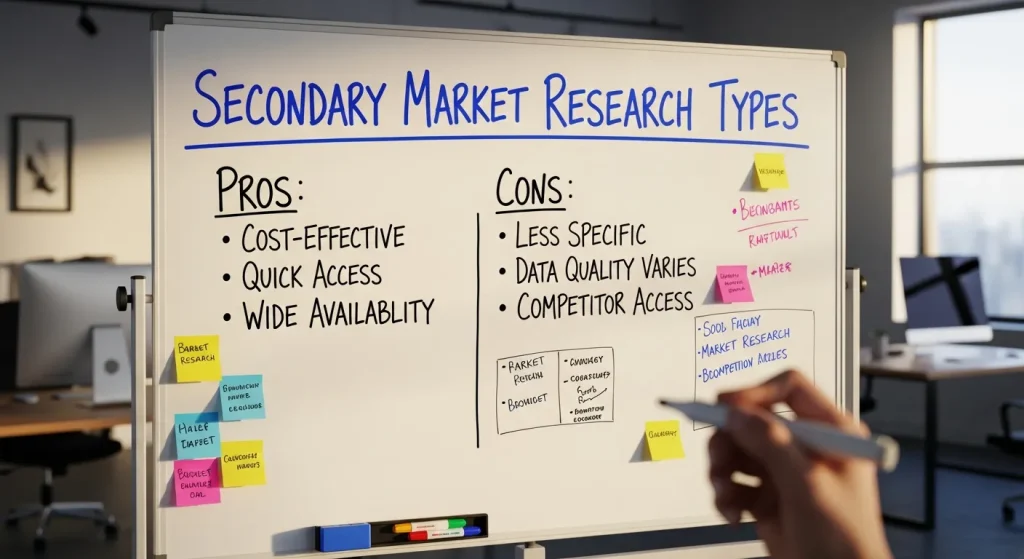
Advantages of Secondary Research
-
Cost-Effective
With the information already assembled, secondary research can save a company money compared to the high-priced prospect of conducting primary research, such as a focus group or poll. -
Time-Saving
It is also much faster to tap existing studies, reports or data than to organize research from the ground up. -
Enhanced Context
Secondary research can put your business into perspective as part of the larger industry picture, allowing you to see the big picture. -
Accessibility of Data
There are so much data from authoritative sources like government agencies, research reports, and academic papers for you to get freely.
Secondary Research Limitations
-
Lack of Specificity
Secondary research may not be created specifically for your own needs, so it might not be as applicable. -
Outdated Information
Data can be too slow, particularly for rapidly evolving industries where old information feels dated. -
Data Bias
Historical data (secondary) is characterised by its inherent bias originating in the interest and need of the collector.
Secondhand research, however, is a valuable tool to be used with care. When asking what secondary market research is, you must also consider its potential pitfalls.
Key Differences Between Primary and Secondary Market Research
Understanding the differences between primary and secondary market research is essential for choosing the right approach for your business needs. Here’s a breakdown:
Primary and secondary market research serve different purposes but are often complementary. Primary research involves gathering new data directly from sources, such as surveys, interviews, or focus groups. It is tailored to specific business needs but can be time-consuming and costly. On the other hand, secondary research leverages existing data, making it a quicker and more cost-effective option. However, it may lack the specificity required for niche or unique business questions.
Key Points:
- Primary Research: Collects new, specific data through direct methods.
- Secondary Research: Analyzes pre-existing data from credible sources.
- Cost and Time: Primary research is more expensive and time-intensive, while secondary research is cost-effective and faster.
- Applicability: Primary research is ideal for unique needs, while secondary research provides a broader industry perspective.
Comparison of Primary and Secondary Market Research
| Aspect | Primary Research | Secondary Research |
|---|---|---|
| Data Source | New data collected firsthand | Existing data from external/internal sources |
| Cost | High | Low |
| Time | Time-intensive | Quick |
| Specificity | Highly specific to business needs | May lack specificity |
| Examples | Surveys, interviews, focus groups | Reports, articles, government data |
Secondary Market Research Types
Internal Sources
Internal data is any information that your organization already has and can sometimes be very rich for research.
-
Sales Records
Researching sales data can help you identify key trends in customer behavior, product performance and seasonality. -
Customer Databases
Your CRM tools are full of data that you can use to segment customers based on what they like, where they live, what they bought, and much more. -
Financial Reports
Past financial information is a good guide to achieve revenue and expense estimates and overall business performance. -
Employee Feedback
Internal surveys or employee feedback can surface operational improvements and customer insights from those who are closest to the data.
External Sources
External data is information collected by a third party, typically focused on general industry or macroeconomic trends.
-
Government Reports
Detailed market information for specific industry sectors will be made available. The U.S. Census Bureau, for instance, provides comprehensive data on demographics and consumer behavior. -
Industry Publications
Trade publications, research firms and news organizations usually have information about market trends that may not be as aboveboard. -
Academic Studies
Market studies are often run by universities or research institutions into conditions in the market, for consumer preferences that are available if a new technology occurs. -
Competitor Data
Publicly shared competition reviews, press releases, or annual reports can be very helpful in understanding industry standards.
If you’re still asking what is secondary market research is, knowing these source types will help clarify its broad applicability.
Best Practices for Conducting Secondary Market Research
To maximize the value of secondary market research, businesses should follow best practices that ensure accuracy, relevance, and actionable insights.
Conducting effective secondary market research requires a strategic approach. By setting clear objectives, evaluating data sources, and validating findings, businesses can extract meaningful insights. Combining internal and external data sources often yields the most comprehensive results. Additionally, leveraging technology and tools can streamline the research process and improve efficiency.
Best Practices:
- Define Clear Objectives: Identify what you aim to achieve, such as understanding customer preferences or benchmarking competitors.
- Evaluate Data Sources: Assess the credibility, relevance, and timeliness of the data.
- Combine Data Sources: Use a mix of internal (e.g., CRM data) and external (e.g., government reports) sources for a holistic view.
- Validate Findings: Cross-check data with multiple sources to ensure accuracy and minimize bias.
- Leverage Technology: Use tools like analytics software and market research platforms to simplify data collection and analysis.
Checklist for Effective Secondary Market Research
| Step | Action |
|---|---|
| Set Objectives | Define the purpose and goals of your research. |
| Identify Sources | List credible internal and external data sources. |
| Assess Credibility | Evaluate the reliability and relevance of each source. |
| Analyze Data | Look for patterns, trends, and actionable insights. |
| Validate Findings | Cross-reference data with other sources to ensure accuracy. |
| Implement Insights | Apply findings to business strategies and test through small initiatives. |
Secondary Market Research: How to Research Your Industry Market
Step 1. Establish Your Objectives for the Study
Begin by clarifying just what you want. Are you looking into new markets? Benchmarking competitors? Understanding the preferences of the consumer? An awareness of your objectives will help ensure that your research is directed and relevant.
Example Research Objective
“Insight in the competitive environment for sustainable packaging solutions in the retail segment.”
Step 2. Datasource Identification and Assessment
When you know your aim, write a list of the sources you can turn to. Make sure to evaluate:
- The publication or institution’s credibility
- How relevant is the data to your needs
- How recently was the information last updated in order to reflect current trends
Pro Tip
Combine those sources! For instance, rely on government reports for industry averages and then layer in CRM data for customer-specific insights.
This is a vital part of understanding what secondary market research is in practical terms.
Step 3. Interpret Your Findings
It’s in the analysis where the magic lies, once the data is collected. Search for patterns, correlations, and actionable insights that address your original research questions. Cross-check with other sources to verify and minimize bias.
Example
If commissioned external research states that more and more people are eating plants, and your own sales data shows an increase in the number of vegetarian dishes being ordered, it suggests it’s a carnivorous expansion.
Step 4. Validate Findings
Finally, share your findings with stakeholders and, if you can, try them out in small initiatives or pilots. This is a good way to make sure that your data is aligned with your business strategy.
Understanding what secondary market research is also means knowing how to act on the insights it provides.
Real-Life Examples of How Secondary Market Research Is Put into Play

Example 1: Launching a New Product
Imagine a food delivery start-up planning to expand its menu offerings. By conducting secondary market research, the company can analyze external reports from market research firms and industry publications. These reports might reveal a growing demand for vegan and plant-based meals due to shifting consumer preferences toward healthier and more sustainable options. Additionally, the start-up can review competitor data, such as press releases or menu updates, to identify gaps in the market.
To complement this, the company can analyze its internal customer data, such as order histories and feedback, to identify trends in customer preferences. For instance, if a significant portion of customers frequently orders vegetarian dishes, this insight aligns with the external data. By combining these findings, the start-up can confidently launch a plant-based menu, knowing there is both external demand and internal interest. This approach minimizes risk and ensures the new product resonates with its target audience.
Example 2: Expanding to a New Market
A retail company considering international expansion can use secondary market research to evaluate potential markets. Government reports and demographic data from organizations like the U.S. Census Bureau or the World Bank can provide insights into population size, income levels, and consumer spending habits in different regions. For example, if the company specializes in sustainable fashion, it might look for markets with a high percentage of environmentally conscious consumers.
Additionally, the company can analyze competitor case studies and annual reports to understand how similar businesses have performed in those markets. For instance, if a competitor successfully entered a specific country by emphasizing eco-friendly practices, this strategy could be adapted. By layering this external data with internal sales performance metrics, the company can identify the most promising markets and develop a tailored entry strategy.
Example 3: Benchmarking Competitors
A beauty brand aiming to improve its digital marketing strategy can use secondary market research to benchmark its competitors. By analyzing industry publications, social media analytics, and competitor press releases, the brand can identify successful tactics used by others in the industry. For instance, if competitors are leveraging influencer partnerships or specific social media platforms to drive engagement, the brand can adopt similar strategies.
Additionally, the brand can use tools like Google Trends or social listening platforms to track consumer sentiment and identify trending topics in the beauty industry. Combining these insights with internal data, such as website traffic and customer feedback, allows the brand to refine its marketing approach and stay competitive.
Utilising Secondary Market Research for Growth
Secondary research is a critical component of building an informed, data-driven business strategy. If you effectively leverage available internal and external resources, set clear goals, and validate findings, you will surely be able to get the value.
For market research novices or for those who need help analyzing insights, there are tools and platforms that can help make the process easy. They cut down on time wasted and help you make quicker decisions based on sound data.
Now that you know what is secondary market research, you can start using it to gain a strategic advantage and grow your business efficiently.
Frequently Asked Questions (FAQs)
1. What is secondary market research?
Secondary market research involves analyzing data that has already been collected, organized, and published by others, such as government reports, industry publications, or competitor data, to gain actionable insights efficiently.
2. How does secondary research differ from primary research?
Primary research involves collecting new data directly through methods like surveys, interviews, or focus groups. Secondary research, on the other hand, uses pre-existing data from credible internal or external sources.
3. What are the benefits of secondary market research?
Secondary research is cost-effective, time-saving, and provides valuable context by leveraging existing data. It allows businesses to make informed decisions without the expense and effort of conducting primary research.
4. What are the limitations of secondary research?
Secondary research may lack specificity, as it is not tailored to your unique needs. Additionally, it can include outdated information or biased data, which may limit its applicability and accuracy.
5. What are examples of secondary research sources?
Examples of secondary research sources include government reports, industry publications, academic studies, competitor data, sales records, and customer databases. These sources provide a mix of macro and micro-level insights.
6. How can secondary research help in decision-making?
Secondary research helps businesses understand market trends, customer behavior, and competitive landscapes. It provides a foundation for data-driven decisions, enabling companies to strategize effectively and reduce risks.
7. Can secondary research be used for B2B marketing strategies?
Yes, secondary research is essential for B2B marketing strategies. It offers insights into industry trends, competitor benchmarks, and customer preferences, helping businesses create targeted and effective marketing campaigns.
8. How do I validate secondary research findings?
To validate secondary research findings, cross-reference data from multiple credible sources. Additionally, test insights through small-scale initiatives or pilots to ensure they align with your business objectives.
9. What tools can assist with secondary market research?
Tools like CRM platforms, data analytics software, and market research databases can simplify the process of collecting, analyzing, and interpreting secondary data, making research more efficient and accurate.
10. Why is secondary research important for data-driven marketing?
Secondary research provides a reliable foundation of data, enabling businesses to create informed, targeted, and effective marketing strategies. It supports decision-making and helps optimize campaigns for better results.



Leave a Reply