

B2B Data-Driven Marketing: More Than a Buzzword Theme. This is a strategic method that uses data to make marketing decisions, reach the right audience, and improve campaigns. For B2B marketers, this approach ushers in a new era, unlocking insights that improve the understanding of buyers, personalization of communications, and ultimately, results.
If you’ve ever wondered how data can change your marketing forecast or want to polish your next B2B campaigns, this one’s for you! By the time you finish reading through this article, you’ll walk away with a comprehensive understanding of what B2B data-driven marketing is, why it’s important, and how you can successfully implement it into your own strategies.
Understanding the Importance of Data in B2B Marketing
The B2B buyer’s journey is complex and has many touchpoints and decision-makers. Guesswork or relying on stale approaches just won’t fly in today’s competitive market. This complexity has data at the core, which gives us quantifiable insights into our customers’ behavior, preferences, and needs.
Here are a few reasons why data is crucial for B2B marketing:
- Accurate Audience Targeting: By leveraging data you can uncover and continuously perfect your target audience reaching the right companies and decision-makers.
- Improved Personalization: Customers have come to expect a personalized experience. Data allows marketers to provide relevant content according to the customer’s behavior, stages of buyer’s journey, and demographic information.
- Measurable ROI: Thanks to data-abounding insights, marketers can better track out how campaigns have performed and accordingly allocate budgets toward those channels and efforts that deliver best.
- Predictive Analysis: Marketers can identify future trends using historical data, analyze market opportunities, and keep ahead of competitors.
Key Components of a B2B Data-Driven Strategy

Understanding these components and how they interrelate is critical for creating a successful data-driven strategy that generates insights we can act on. Here’s how the major pieces break down:
- Clear Goals and KPIs:
Start by articulating your measurable goal, whether that’s the quality of leads, conversion rates or customer retention. Create KPIs (key performance indicators) relevant to these objectives to track success.
- Robust Data Collection:
The foundation of any data-driven strategy is collecting accurate and useful data. First-party data: Exploring first-party data from internal systems, second-party from partnerships and third-party data from external sources.
- Integrated Marketing Technology Stack:
Utilize MarTech ( Marketing Technology) tools – Like CRM systems, automation platforms, analytics tools, etc to centralize the data and streamline the workflow for a campaign.
- Segmentation and Targeting:
Group prospects and customers into specific segments based on their industry, company size, job roles, or behavior to deliver tailored experiences.
- Analytics and Insights:
Advanced analytics help you interpret the data you’ve gathered, allowing you to create strategies backed by actionable insights.
- Ongoing Optimization:
Continuously monitor your campaigns, analyze results, and adjust your strategy to ensure you’re always improving and achieving maximum efficiency.
How to Collect and Analyze B2B Marketing Data
Understanding how to collect and interpret data effectively is at the core of data-driven marketing. Follow these steps to streamline your approach:
1. Data Collection
- Website Analytics:
Tools like Google Analytics provide insights into visitor behavior, such as page views, time spent on-site, and conversion events.
- CRM Systems:
Customer relationship management platforms store valuable sales and customer data.
- Social Media Insights:
Use analytics from LinkedIn and Facebook to gauge audience engagement and identify customer interests.
- Third-Party Data Providers:
Collaborate with data providers to supplement your first-party information with new customer insights.
2. Data Analysis
Once you’ve collected data, use these methods to analyze and derive meaningful insights:
- Identify Patterns:
Look for recurring themes or patterns in your data, such as which touchpoints are generating the most engagement.
- Use Predictive Models:
Leverage AI-powered tools to predict customer behavior based on historical trends.
- Visualize Data:
Data visualization platforms like Tableau or Power BI simplify complex datasets into digestible charts and graphs.
Implementing Data-Driven Insights in B2B Campaigns
Data is only valuable if it’s put into action. Here’s how to integrate data-driven insights into your campaigns:
- Refine Messaging:
Use data to understand customer pain points and craft messaging that speaks directly to their needs and challenges.
- Personalize Emails and Content:
Leverage behavioral and demographic data to deliver content that resonates with specific audience segments.
- Optimize Lead Scoring:
Improve your lead scoring models by incorporating data on customer engagement and intent.
- A/B Testing:
Test different versions of campaigns, such as email subject lines or landing pages, and use the data to optimize performance.
Examples of Successful B2B Data-Driven Marketing
Many companies have successfully implemented data-driven marketing strategies. Here are two noteworthy examples:
- HubSpot:
The inbound marketing platform uses data-driven insights to create content, enhance lead generation, and personalize email campaigns. This approach has helped them achieve better customer engagement and higher conversion rates.
- IBM Watson:
Through AI and predictive analytics, IBM’s Watson platform helps clients optimize their marketing campaigns, ensuring the right message gets delivered to the right audience at the perfect time.
Challenges and Solutions in B2B Data-Driven Marketing
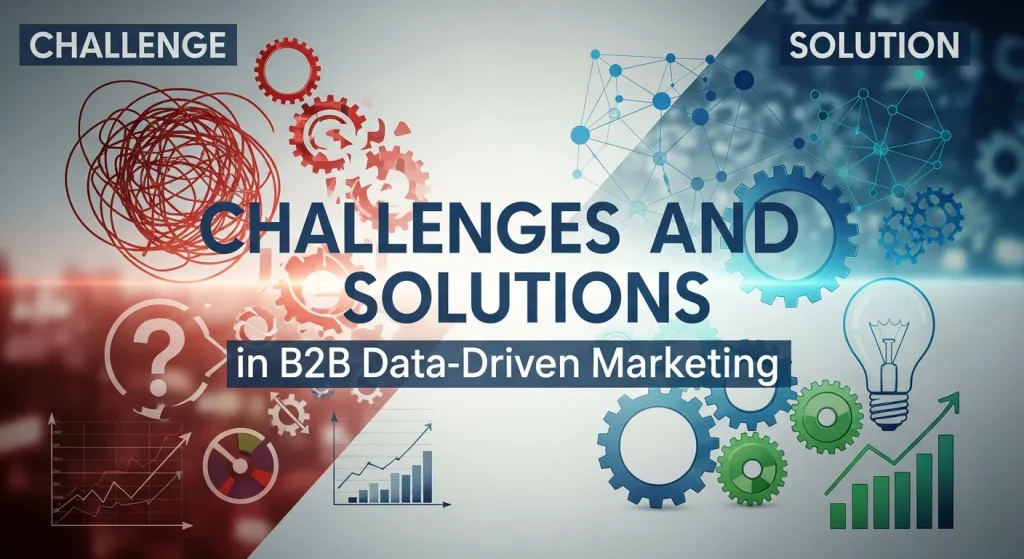
While data-driven marketing offers numerous benefits, there are also challenges that organizations must address:
Common Challenges:
- Data Silos:
Data stored across disparate systems can create inconsistencies and inefficiencies.
- Privacy Regulations:
Laws like GDPR and CCPA require businesses to handle data ethically and transparently.
- Data Overload:
Companies are collecting massive amounts of data, but not all of it is useful.
Solutions:
- Invest in Data Integration Tools:
Use tools that unify data sources into one accessible location.
- Stay Compliant:
Regularly update your data handling processes to comply with privacy laws.
- Focus on Quality Over Quantity:
Prioritize collecting relevant, high-quality data rather than simply amassing large volumes.
The Shift from Traditional to Data-Driven Marketing
The landscape of B2B marketing has changed dramatically over the past decade. Companies no longer rely solely on intuition or past experience to guide campaigns. Instead, B2B data-driven marketing has emerged as the cornerstone of modern marketing strategies, enabling organizations to base every decision on factual insights rather than guesswork. As businesses adopt this approach, marketing becomes data-driven in a more meaningful way, allowing marketers to track buyer behavior, engagement patterns, and conversion trends in real time. This transition not only improves efficiency but also strengthens the alignment between marketing and sales teams, ensuring that resources are focused on the channels and strategies that deliver measurable results. The evolution from traditional campaigns to data-driven initiatives highlights why companies use data driven marketing to maintain a competitive edge in a fast-paced market.
Integrating Data Across the Buyer’s Journey
A successful B2B data-driven marketing strategy requires a holistic view of the buyer’s journey. Every interaction a prospect has with your brand generates data, from website visits and email engagement to social media interactions and product inquiries. By integrating this data across all touchpoints, companies can gain a clear understanding of where prospects are in their decision-making process. Marketing becomes data-driven not just at the campaign level, but across the entire sales funnel. This integration allows teams to tailor messaging and content according to buyer behavior and preferences, ultimately leading to higher engagement and stronger conversions. For businesses looking to scale, this approach ensures that each marketing dollar contributes to a cohesive, measurable strategy, reinforcing the importance of adopting a data-driven mindset.
Predictive Insights and Forward-Looking Strategies
One of the most powerful aspects of B2B data-driven marketing is its ability to provide predictive insights. Historical data, when analyzed correctly, can help marketers anticipate trends, forecast buyer behavior, and identify potential challenges before they arise. Companies use data driven marketing not only to evaluate past campaign performance but also to predict which actions will yield the best results in the future. Predictive analytics tools allow marketing teams to make proactive decisions, such as determining the optimal timing for outreach or identifying the most promising leads for the sales team. This forward-looking capability distinguishes successful data-driven marketing guide approaches from traditional reactive methods, positioning businesses to stay ahead of competitors and maximize ROI.
Enhancing Personalization Through Data
Personalization has become a non-negotiable expectation for modern B2B buyers. Generic messaging or one-size-fits-all campaigns are no longer effective. With B2B data-driven marketing, companies can leverage insights to create highly personalized experiences that resonate with specific audience segments. By analyzing engagement data, demographic information, and previous interactions, marketers can tailor content, email campaigns, and offers to align with individual buyer needs. This not only increases engagement and trust but also strengthens the overall customer relationship. As more companies recognize the benefits of personalized outreach, marketing becomes data-driven in a more nuanced way, shifting the focus from broad campaigns to highly targeted, behavior-informed strategies that drive real results.
Measuring Success and Continuously Optimizing
The hallmark of B2B data-driven marketing is its emphasis on measurement and continuous optimization. Unlike traditional marketing, where success was often gauged by intuition or surface-level metrics, data-driven approaches rely on quantifiable KPIs. Metrics such as lead conversion rates, engagement scores, pipeline velocity, and ROI are tracked meticulously to understand campaign performance and identify areas for improvement. Companies use data driven marketing to not only evaluate outcomes but also to refine strategies in real time, adjusting messaging, targeting, and channel allocation as insights evolve. This iterative approach ensures that marketing efforts are constantly optimized for efficiency, effectiveness, and scalability. Over time, organizations that embrace this model gain a significant advantage, as they are able to respond to market shifts, buyer expectations, and competitive pressures with agility and precision.
Best Practices for B2B Data-Driven Marketing
Implementing a B2B data-driven marketing strategy successfully requires careful planning and adherence to best practices. By following these practices, companies can ensure their marketing becomes more precise, efficient, and impactful.
Key Best Practices:
- Prioritize Clean Data: Ensure data accuracy by regularly auditing and removing duplicates or outdated records.
- Segment Audiences Effectively: Divide your audience into meaningful groups based on industry, job role, behavior, or engagement.
- Leverage Automation Tools: Use marketing automation platforms to streamline campaign execution, nurture leads, and personalize outreach.
- Align Sales and Marketing: Ensure sales teams have access to marketing insights to optimize lead conversion.
- Measure and Optimize: Continuously monitor KPIs and adjust campaigns for better performance.
Example Workflow :
| Practice | Purpose | Tools / Methods |
|---|---|---|
| Data Cleaning | Maintain data accuracy | CRM audits, Excel validation |
| Audience Segmentation | Deliver tailored messaging | HubSpot, Marketo, custom filters |
| Marketing Automation | Streamline campaigns | HubSpot, Pardot, ActiveCampaign |
| Sales Alignment | Convert leads efficiently | CRM integration, dashboards |
| Performance Optimization | Maximize ROI | Google Analytics, Tableau, Power BI |
Common Mistakes in B2B Data-Driven Marketing
Even with the right strategy, many companies fail to fully benefit from data-driven marketing due to avoidable mistakes. Recognizing these pitfalls early can prevent wasted resources and poor ROI.
Common Mistakes:
- Ignoring Data Privacy: Non-compliance with GDPR/CCPA can lead to legal penalties and damage reputation.
- Overlooking Data Quality: Using inaccurate or incomplete data leads to misinformed decisions.
- Neglecting Continuous Testing: Failing to A/B test campaigns reduces opportunities to optimize performance.
- Focusing Only on Volume: Collecting large amounts of irrelevant data can create overload without insights.
Mistake vs Solution Table:
| Mistake | Consequence | Solution |
|---|---|---|
| Ignoring Data Privacy | Legal penalties, lost trust | Implement strict compliance policies, regular audits |
| Poor Data Quality | Misleading insights | Regular data cleaning and validation |
| Skipping Testing | Suboptimal campaigns | Implement A/B testing and optimization cycles |
| Data Overload | Confusion, inefficiency | Focus on relevant, high-quality data collection |
The Future of B2B Data-Driven Marketing

The evolution of technology will continue to reshape data-driven marketing. Here are a few trends to watch for:
- AI and Machine Learning:
AI will play a growing role in analyzing complex datasets and automating decisions.
- Predictive Analytics:
Businesses will increasingly rely on predictive models to forecast trends and behavior.
- Real-Time Data Processing:
Faster data processing capabilities will enable marketers to make decisions on-the-fly.
Harness Your Data to Drive Success
B2B data-driven marketing has great potential for businesses to know their audience and create campaigns capable of generating engagement, ROI, and growth. By taking a clear strategy, implementing good tools, and working on actionable insights, you can make data a key player in your journey to growth.
Need to elevate your B2B campaigns? Discover powerful tools to take control of your marketing data. Get started today and unlock smarter, data-driven strategies.
Frequently Asked Questions (FAQs)
1. What is B2B data-driven marketing?
B2B data-driven marketing is a strategy where companies use data insights from customer behavior, engagement, and analytics to guide marketing decisions, improve personalization, and enhance ROI.
2. Why is data-driven marketing essential for B2B companies?
It provides measurable insights into target audiences, enables precise segmentation, supports predictive decision-making, and improves campaign effectiveness, ensuring that marketing budgets are spent efficiently.
3. How can small B2B companies use data-driven marketing?
Even small companies can collect website, CRM, and social media data to personalize campaigns, track ROI, segment audiences, and make informed decisions without expensive tools.
4. What types of data are most useful in B2B marketing?
Useful data includes behavioral insights, demographic data, engagement metrics, purchase history, company size, industry trends, and historical campaign performance.
5. Which tools help implement a B2B data-driven marketing strategy?
CRM platforms like HubSpot, marketing automation tools like Marketo, analytics platforms like Google Analytics, and visualization tools like Tableau or Power BI.
6. How can data improve lead scoring?
By analyzing past engagement, behavior, and demographic information, data-driven lead scoring allows marketers to prioritize high-quality leads more effectively.
7. What role does predictive analytics play in B2B marketing?
Predictive analytics identifies trends, forecasts buyer behavior, and anticipates market opportunities, enabling marketers to act proactively rather than reactively.
8. How can companies avoid data silos?
By integrating all data sources into centralized platforms, teams can access consistent insights, streamline collaboration, and make informed decisions efficiently.
9. What are the key challenges in B2B data-driven marketing?
Challenges include data overload, poor data quality, privacy compliance, fragmented systems, and lack of skilled personnel to analyze and act on insights.
10. How long does it take to see results from B2B data-driven marketing?
Results vary depending on campaign complexity and data maturity, but many companies begin to see measurable improvements in engagement, lead quality, and conversions within three to six months.



Leave a Reply