

Must Read: If Your Marketing Isn’t Data-Driven, Then You’re Already Behind Data-Driven Marketing: The world of data-driven marketing. The new measurement-based marketing approach revolutionizes how businesses reach their customers to build powerful campaigns powered by insights and measurable results
So what exactly is data-driven marketing? What does it mean for you and your organization, and how might you use it? What tools and challenges, and opportunities should you be aware of? In this blog, we will answer those questions and describe some of the key things needed to move towards a data-driven strategy. So, by the time you finish reading this guide, you will realize that data-driven marketing is not merely a fancy bullshit or buzz marketing term, but rather a critical necessity to remain relevant in this fast-changing world of digital marketing.
What Is Data-Driven Marketing and Why Is It Important?
Data-driven marketing involves the practice of using customer data to design, customize, and optimize marketing strategies. In contrast to conventional marketing, which tends to be based on assumptions and instinct, data-driven marketing gives precedence to quantifiable insights to help make more informed and smarter decisions.
Here’s why it matters:
- Personalization: By analyzing user behavior, preferences, and demographics, marketers can deliver personalized experiences, which lead to increased engagement and conversion rates.
- Better ROI: Data-driven insights help identify which channels, campaigns, and strategies are most effective, ensuring resources are allocated efficiently.
- Improved Customer Understanding: Data unlocks a deep knowledge of your audience, helping you anticipate needs, refine messaging, and foster long-term loyalty.
- Competitive Edge: With so much competition in every industry, leveraging data gives you the ability to act quickly on trends and proactively address customer pain points.
Is your marketing strategy truly data-driven? If you’re not using analytics to prove results and refine campaigns, there’s room to improve.
Understanding Key Data Metrics in Marketing
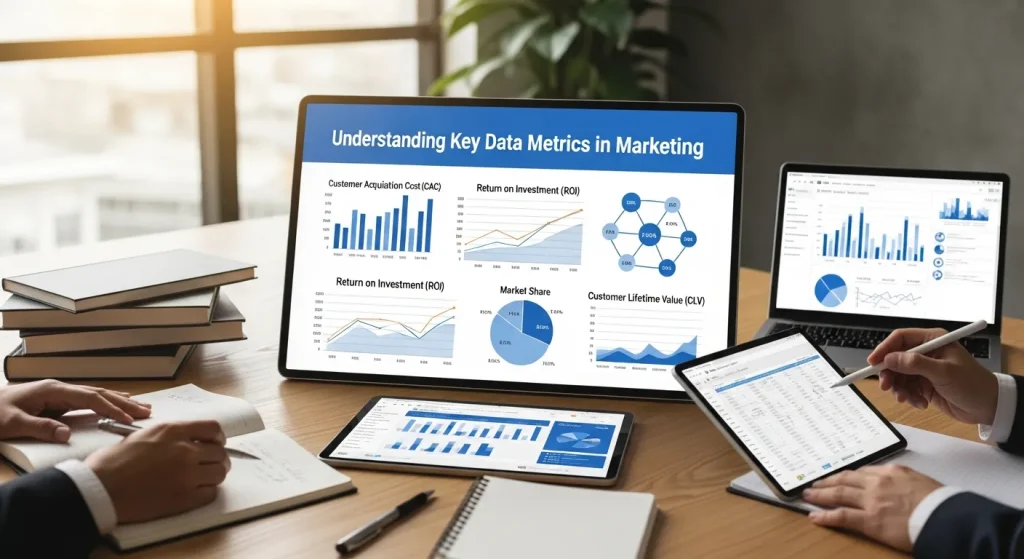
For a data-driven approach to work, it’s critical to know which metrics are meaningful and actionable. Here are some essential key performance indicators (KPIs) to track:
1. Return on Investment (ROI)
ROI measures the profitability of your campaigns by comparing what you spend to the revenue generated.
- Formula example: (Net Revenue – Marketing Expenses) ÷ Marketing Expenses
- Why it’s important: It shows whether the campaign adds value or drains resources.
2. Customer Lifetime Value (CLV)
CLV represents the total revenue you can expect to earn from a customer over their relationship with your brand.
- Why it’s important: It helps businesses identify their highest-value segments and decide where to focus retention efforts.
3. Conversion Rate
This is the percentage of users who take a specific desired action, such as signing up for a newsletter, downloading an eBook, or completing a purchase.
- Why it’s important: It gauges how effective your marketing efforts are at driving meaningful outcomes.
4. Click-Through Rate (CTR)
CTR measures the number of clicks your ad or link receives divided by the number of impressions.
- Why it’s important: It helps assess the effectiveness of ad creatives, email campaigns, or social media posts.
By continuously monitoring these metrics, you can refine marketing efforts to deliver measurable results.
Tools and Technologies for Data-Driven Marketing
Data-driven marketing uses technology to its full potential. Without the proper tools, making sense takes a back seat to the chaos (to the point of impossibility). As you begin building out your project, here are some tool categories that are worth considering:
1. Analytics Platforms
Platforms like Google Analytics and Adobe Analytics show how users interact with your site, their journey, and what gets them to convert. By utilizing these tools, businesses can:
- Track KPIs
- Optimize campaigns
- Run A/B tests
2. Customer Relationship Management (CRM) Software
Platforms such as Salesforce, HubSpot, and Zoho allow you to maintain relationships throughout the customer lifecycle. CRMs are used to gather and structure customer information for better alignment between sales and marketing functions.
3. Email Marketing Tools
Tools such as Mailchimp or Klaviyo allow you to set up targeted email campaigns. They also provide analytics on open rates, click-through percentages and more.
4. Marketing Automation Software
Solutions such as Marketo or ActiveCampaign automate workflows, behaviorally segment audiences, and help lessen manual work.
5. Social Media Management Tools
ILLAINS systems help to create proprietary ad platforms with rainbow insights” Usually available with social platforms! For instance, Meta Ads Manager or LinkedIn Campaign Manager provide real-time targeting data for your paid advertising campaigns.
Even small teams can implement data-driven strategies aligned with their organizational structure using these tools.
How to Implement a Data-Driven Marketing Strategy
You need to have a plan and execute on it — tools are just the beginning to a strong data-driven strategy. Here’s a short, step-by-step breakdown:
Step 1: Define Clear Goals
Know before you collect data what you want to measure. Are you concentrating on scaling sales? Improving engagement? Targeting a Specific Audience for Retargeting?
Step 2: Collect the Right Data
Collect data from different touchpoints: social media engagement, email campaigns, website analytics, etc. If you collect any data, make sure you comply with the data protection regulations like the GDPR or the CCPA.
Step 3: Analyze Your Data
Consider automated reports or staff data analysts to isolate trends, opportunities and bottlenecks. This phase is key to translating raw figures into insights.
Step 4: Segment Your Audience
Segment your customer base into categories like “loyal buyers” or “newly signed-up users.” Customize campaigns around the unique preferences of each segment.
Step 5: Experiment and Optimize
Experiment with different marketing strategies (for example A/B testing) to assess performance. Harness this information to adjust and grow subsequent campaigns.
Step 6: Take Action
After you listen, act on what you hear. Run campaigns, tailor customer experiences and edit live activities based on up-to-the minute information..
The Role of Data-Driven Marketing in B2B Growth
In today’s highly competitive business landscape, b2b data driven marketing has become a critical growth driver for organizations seeking sustainable success. Unlike traditional marketing approaches that rely on assumptions or generalized messaging, data-driven marketing enables B2B companies to gain deep insights into buyer behavior, intent signals, and decision-making patterns. By analyzing data from CRM platforms, website interactions, content engagement, and sales funnels, businesses can identify high-value leads and tailor messaging to address specific business challenges. This targeted approach leads to stronger relationships, shorter sales cycles, and improved lead quality. B2B marketers can also track long-term performance metrics, allowing them to refine strategies continuously and ensure consistent ROI. As B2B buying journeys become increasingly complex and research-driven, companies that adopt data-driven marketing strategies gain a clear advantage by delivering relevant, personalized, and timely communication that resonates with decision-makers.
Top Data-Driven Marketing Trends Shaping the Future
Data-driven marketing continues to evolve rapidly with advancements in AI, automation, and real-time analytics. Businesses adopting these trends gain better audience insights, increased engagement, and higher campaign efficiency. Staying ahead of these trends is essential for sustainable digital growth.
Key Trends in Data-Driven Marketing
- AI-powered personalization
- Predictive analytics for customer behavior
- Marketing automation workflows
- Omnichannel customer journey tracking
- Voice and visual search data integration
Benefits of These Trends
- Improved campaign accuracy
- Higher engagement and conversions
- Better ROI measurement
- Real-time decision-making
- Enhanced customer experience
Trend Impact Table
| Trend | Purpose | Business Impact |
|---|---|---|
| AI Personalization | Customized content delivery | Higher engagement & conversions |
| Predictive Analytics | Forecast user behavior | Better campaign planning |
| Automation Tools | Streamlined workflows | Time & cost savings |
| Omnichannel Tracking | Unified customer data | Improved customer journey |
| Real-Time Analytics | Instant performance monitoring | Faster optimization |
How to Develop a Data Driven Marketing Strategy That Delivers Results
To truly succeed, businesses must understand how to develop a data driven marketing strategy that aligns with both short-term objectives and long-term growth goals. The process begins with establishing clear marketing objectives, followed by collecting accurate and relevant data across multiple channels. Businesses should focus on building a strong data foundation using analytics tools, CRM platforms, and customer feedback systems. Once data is collected, advanced analytics and AI-powered tools can transform raw information into actionable insights. This enables marketers to identify patterns, predict customer behavior, and design targeted campaigns that address real customer needs. Over time, continuous monitoring and optimization ensure that marketing efforts remain effective and adaptable to changing market conditions. By focusing on precision, personalization, and performance measurement, businesses can build a scalable data-driven framework that consistently delivers higher engagement, improved conversion rates, and sustainable revenue growth.
Successful Data-Driven Marketing Campaigns
Examples are the best way to learn the potential of data-driven marketing; Here are two fresh shows that stood out:
1. Spotify’s “Wrapped” Campaign
As it does annually, Spotify looks at users’ listening behaviors and generates customized “Wrapped” recaps to distribute. This is a very user-specific, data-driven campaign that drives user engagement and loyalty through social.
2. Amazon’s Personalized Recommendations
In fact, Amazon applies artificial intelligence and data analytics to shoppers, recommending products based on their individual histories and behavior and accounting for a significant portion of its e-commerce dominance.
Understanding What Is a Data Driven Marketing Strategy in Modern Digital Marketing
Many businesses still struggle to clearly define what is a data driven marketing strategy and how it differs from conventional marketing approaches. At its core, a data-driven marketing strategy relies on the systematic use of data, analytics, and technology to guide decision-making, optimize campaigns, and improve customer experiences. Rather than depending on assumptions or generic targeting, marketers analyze customer behavior, preferences, and interaction patterns to craft highly relevant messages. This approach allows businesses to engage users at the right time, through the right channel, with the right content. In modern digital marketing, this strategy extends beyond simple performance tracking and evolves into predictive modeling, real-time personalization, and automated optimization. By integrating artificial intelligence, marketing automation, and advanced analytics, companies can continuously refine their messaging and maximize campaign effectiveness. Ultimately, data-driven marketing strategies empower brands to move from reactive decision-making to proactive, insight-led marketing that drives measurable growth.
How to Develop a Data-Driven Marketing Strategy Step-by-Step
Developing a strong data-driven marketing strategy requires clear objectives, reliable data sources, and continuous optimization. A structured approach ensures that marketing decisions are based on insights rather than assumptions.
Step-by-Step Strategy Framework
- Define measurable marketing goals
- Collect accurate and relevant data
- Analyze performance metrics
- Segment your audience
- Implement automation tools
- Continuously test and optimize campaigns
Benefits of a Structured Strategy
- Increased efficiency
- Reduced marketing waste
- Higher conversion rates
- Better customer targeting
- Improved ROI
Strategy Implementation Table
| Step | Action | Outcome |
|---|---|---|
| Goal Setting | Define KPIs | Clear performance targets |
| Data Collection | Use analytics tools | Accurate insights |
| Data Analysis | Identify trends | Smarter decisions |
| Segmentation | Group audiences | Personalized campaigns |
| Optimization | Test & refine | Higher ROI |
Why Top Data-Driven Marketing Trends Are Reshaping Digital Strategy
Keeping up with top data-driven marketing trends is essential for brands looking to stay competitive in an increasingly data-centric world. Emerging technologies such as artificial intelligence, predictive analytics, and machine learning are transforming how marketers collect, interpret, and apply customer insights. Real-time data processing enables brands to respond instantly to customer behavior, delivering personalized experiences that drive engagement and loyalty. Omnichannel analytics allow businesses to unify customer interactions across websites, mobile apps, email campaigns, and social platforms, providing a holistic view of the buyer journey. Additionally, advancements in automation are helping teams streamline workflows, reduce operational costs, and improve campaign accuracy. As these trends continue to evolve, organizations that proactively embrace innovation will gain the ability to anticipate market shifts, identify growth opportunities, and build meaningful customer relationships. Staying aligned with these trends ensures that marketing strategies remain future-ready, scalable, and resilient.
Overcoming Challenges in Data-Driven Marketing
But data-driven marketing isn’t without its challenges. Here’s how to work through some common roadblocks:
- Privacy Concerns: With increasing data protection laws, make sure that customer data is collected, stored, and utilized ethically.
- Data Quality Issues: Invest in the platforms or processes to clean data and maintain accuracy.
- Organizational Buy-In: Help internal stakeholders understand the business case and ROI for data-driven decisions.
The Future of Data-Driven Marketing
The future is bright (and intelligent). This will take data-driven marketing to the next level, through AI tools, real-time data processing, and predictive analytics. With the ability to use AI for personalized, scalable marketing, businesses that can leverage it will stay ahead of the competition. Input your data up to October 2023.
Start Making Data Work For You Today
The data-driven delivery of marketing is no longer a choice — it has become an equipping tool for better decision-making, smarter campaigns and better ROI. So applying the principles of data-driven marketing, whether you’re a small business or a large enterprise, would give you a big competitive advantage.
Want to get ahead? Sign up for these tools today and explore their insights; Google Analytics and HubSpot. And if you’re ready to take your efforts up a notch, check out AI solutions that can help you make your campaigns smarter and more targeted.
Building Long-Term Success Through Strategic Data-Driven Marketing
Long-term business growth depends on the consistent application of data-driven marketing principles across all customer touchpoints. Successful brands treat data not merely as a reporting tool, but as a strategic asset that informs every stage of the marketing lifecycle. From awareness and acquisition to engagement and retention, data enables businesses to design seamless customer journeys that adapt to evolving expectations. By continuously testing, analyzing, and optimizing campaigns, organizations can improve efficiency while delivering increasingly personalized experiences. Over time, this approach builds trust, enhances brand credibility, and strengthens customer loyalty. Moreover, data-driven strategies foster a culture of continuous learning and innovation, allowing businesses to adapt quickly to market changes. In a digital-first economy, companies that invest in long-term data-driven frameworks position themselves for sustained success, stronger market presence, and higher lifetime customer value.
Frequently Asked Questions (FAQs)
1. What is data-driven marketing and why is it important for modern businesses?
Data-driven marketing is the strategic use of customer data, analytics, and technology to create personalized, targeted, and measurable marketing campaigns. It is important because it improves decision-making, increases customer engagement, enhances ROI, and enables brands to stay competitive in an increasingly digital marketplace.
2. How does data-driven marketing improve customer experience?
Data-driven marketing analyzes customer behavior, preferences, and interactions to deliver personalized messages, relevant offers, and timely communication. This helps brands build stronger relationships, increase satisfaction, and provide consistent, seamless experiences across multiple channels.
3. What are the most important metrics in data-driven marketing?
Key metrics include conversion rate, customer lifetime value (CLV), return on investment (ROI), click-through rate (CTR), engagement rate, and churn rate. Tracking these metrics helps marketers evaluate performance, optimize campaigns, and improve overall marketing effectiveness.
4. How can small businesses implement a data-driven marketing strategy?
Small businesses can start by using free or low-cost analytics tools, tracking website and social media data, automating email campaigns, and segmenting audiences. These simple steps allow them to improve targeting, optimize budgets, and achieve measurable growth efficiently.
5. What tools are essential for successful data-driven marketing?
Essential tools include analytics platforms like Google Analytics, CRM systems such as HubSpot and Salesforce, marketing automation tools, social media management platforms, and AI-based predictive analytics software to optimize targeting and personalization.
6. How does AI enhance data-driven marketing strategies?
AI enhances data-driven marketing by automating repetitive tasks, predicting customer behavior, improving targeting accuracy, personalizing content at scale, and enabling real-time optimization, which leads to higher engagement, better conversion rates, and improved campaign performance.
7. What are the main challenges in data-driven marketing?
Common challenges include poor data quality, data silos, lack of skilled professionals, privacy compliance issues, and resistance to adopting analytics-based decision-making. Overcoming these challenges requires training, proper tools, and organizational commitment.
8. How can businesses measure the success of data-driven campaigns?
Businesses can measure success by tracking KPIs such as ROI, lead quality, conversion rates, engagement metrics, customer retention, and sales growth, allowing continuous improvement and optimization of marketing strategies.
9. What role does customer segmentation play in data-driven marketing?
Customer segmentation allows marketers to group audiences based on demographics, behavior, interests, and purchase history, enabling personalized communication, better targeting, higher engagement, and improved conversion rates across campaigns.
10. Why is data-driven marketing considered the future of digital marketing?
Data-driven marketing is the future because it integrates AI, automation, predictive analytics, and real-time insights, enabling businesses to create highly personalized, efficient, and scalable marketing strategies that adapt to evolving customer behaviors and market trends.



Leave a Reply